Archive for 2008

Mt. Hijiri (聖岳)

December 1, 2008

This blog post was written back in 2008. For the latest information about this hike (including color photos and maps), please consider purchasing my guidebook to the Japan Alps. 

Mt. Hijiri, situated on the border of Nagano and Shizuoka Prefectures, is the southernmost 3000m peak in Japan and home to one of the best panoramic vistas around.

hijiridake1

The hike: Although there are several approaches to the peak, I will describe one of the more popular routes via Tayori-ga-shima (便ヶ島). Fill up your water bottles at the picnic area across the road from the mountain hut near the toilets. There’s no water from here until reaching the hut at Hijiri-daira, so take plenty with you. The trail passes over a short hill before reaching a tunnel, where the trail flattens out for a 4km hike on an old boxcar route (the tracks have been pulled up). This area is absolutely stunning when the autumn leaves have changed color. After about an hour of hiking, you’ll reach the end of the road and find a metal box suspended on a pulley system over the river. This interesting contraption has been built to assist hikers in crossing the river, as it’s nearly impossible to cross without wading through frigid water. Use the ropes to pull the carriage towards you, and hop in. It works much better if you’ve got someone else with you to help with all of the pulling. After crossing the river, the trail makes its way through a series of steep switchbacks until reaching an abandoned mountain hut. This would make a really good place to film a horror movie, so I don’t recommend staying in this place unless you’d like to have some nightmares. Continue climbing past the hut, through a small cedar forest and a never-ending series of switchbacks. There are some steep places, but plenty of ropes tied into the hillside to keep you from falling. After about an hour you’ll see a small clearing to your left, which has fantastic views down to the valley below. The path keeps climbing up and up, through a wonder virgin forest filled with beautiful flora. One thing you’ll notice, however, is that a large percentage of the older trees have fallen, which leads me to believe that a massive typhoon must’ve come through here a few decades ago. Because of the dense foliage, you won’t have much of a view of the peaks until just below the main trail junction, so keep a nice steady pace and your fluid intake up. It should take anywhere from 5 to 7 hours to reach aforementioned junction, which sits on the main Minami Alps traverse route. Take your pack off and enjoy the outstanding scenery. From here, you can either turn left for the 3 hour slog to the summit, or save it for the following morning. I would base your decision on the weather and on your physical condition. If you’re going to the hut, then turn right and head downhill past the fences built to keep the deer from trampling the wildflowers. You’ll reach a junction in about 20 minutes, so turn left and follow the wooden planks to the hut. Check into the hut or pitch your tent in anywhere out front. During the ‘off season’, you can stay in the adjacent emergency hut for free. Just bring a warm sleeping bag and plenty of food. The next day, retrace your steps back up to the junction you came from the previous day. From here, the trail climbs up through a wonderful forest towards the summit of Ko-hijiri (小聖岳). You’ll pop out of the tree line just below the summit of this 2600m peak, and you’ll be rewarded with spectacular views of Mt Hijiri, Mt. Kamikouchi, Mt. Usagi, and Mt. Fuji. From here, you’ve got a fairly straightforward, switchback laden climb to the summit of Hijiri. It looks close but it’ll take around an hour to reach the top. Take a break and congratulate yourself for climbing the southernmost 3000m peak in Japan! On a clear day you’ll have views of the Chuo and Kita Alps, as well as most of the Minami Alps, Mt. Ena, the peaks of Chichibu-Kai-Tama National Park, Mt. Fuji and Mt. Tanzawa. After a well-deserved break, you can either retrace your steps all the way back to Tayori-ga-shima, or continue on the main trekking route towards Mt. Akaishi.

When to go: This hike can be done from early June to early November, when most of the snow is gone. If you’ve got the right equipment and experience, then you can also do this in the winter, since the hut at Hijiri-daira is converted into an emergency hut from September to June.

Access: This is one hike where you’ll need your own car, unless you come from Sawara-jima or Kita-dake. Alternatively, you could take a taxi from Hiraoka (平岡) station on the JR Iida Line, but it’ll cost you close to 20,000 yen! If you’re rich and want to shell out the money, then tell the taxi driver you want to go to Tayori-ga-shima (便ヶ島) and Hijiri-tozanguchi (聖登山口).

Level of difficulty: 5 out of 5 (elevation change ~2100m).
Mt. Suisho (水晶岳)

November 9, 2008

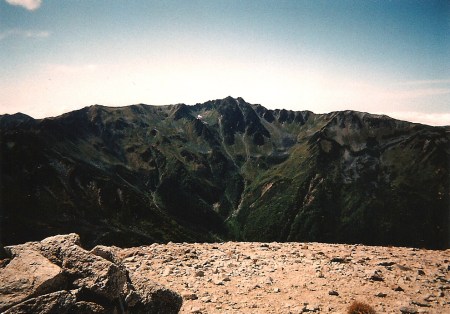
Mt. Suisho, also known as Mt. Kuro, is a spectacular alpine peak located a stone’s throw from Mt. Washiba in the Kita Alps. In fact, most people climb these 2 peaks in succession as a side trip from the main Kamikochi-Tateyama trekking route.

kuro1

The hike: Follow the same instructions for the Mt. Washiba hike. From the top of Mt. Washiba, continue hiking north on the ridge line (up and over Mt. Warimo) until reaching a junction called Iwakoke-norikoshi (岩苔乗越). If you turn left then you’ll soon reach a 3 way junction down to Kumo-no-taira (雲ノ平), but ignore this and continue on the trail in front of you. In about 30 minutes or so you’ll reach the Suisho hut (水晶小屋). Open from mid-July to mid-September, it’s a very small hut with room for only 30 people. Click here for the website. There’s no reliable water source, so make sure you’ve filled up your bottles at the Mitsumata hut before the climb up to Washiba. Leave your pack in front of the Suisho hut and prepare yourself for the short, adrenalin-inducing climb to the summit. Unlike its close neighbor Washiba, Mt. Suisho is a steep, rocky peak with plenty of chains bolted to make things easier. The views from the peak are stunning to say the least. Retrace your steps back to the hut and make a decision about where to go next. You have 3 options. The first option is to retrace your steps all the way back to Mitsumata and the main trekking route. Option 2 is to retreat back to the junction and descending down to Kumo-no-daira. I must admit that it’s one area of the Northern Alps I have yet to explore, but the area looks spectacular and there’s a hidden hot spring at the end of a long valley. The third option would be to take the only trail you haven’t been on, which will take you across a long saddle and over to an adjacent ridge line. This is the route I took and it should take you about 90 minutes or so to reach Mt. Masago (真砂岳). Just before the summit you’ll find a trail junction that leads down to Yumata Hot Spring (湯俣温泉). This is another of Japan’s hidden hot springs, and there are a couple of huts you can stay at. It really is in the middle of nowhere, and it’ll take a few hours to get there from the junction. Unless you’re anxious to get out of the mountains, I’d recommend staying on the ridge for the time being and climb up and over Mt. Masago. 20 minutes past this peak, you’ll be sitting on top of Mt. Noguchigoro (野口五郎岳), which has incredible views back across the valley to Mt. Suisho. It’s from this vantage point that you can see how Suisho also goes by the name of Mt. Kuro. There’s a hut and plenty of fresh water here. If you’ve still got the energy, then I’d recommend continuing along the ridge to Eboshi hut, which is about 2-1/2 hours further north. Click here for the hut website. I made it all the way from Sugoroku hut to this point in one day, but I was carrying a fairly light pack and was acclimatized to the altitude. There’s plenty of room to camp around the hut and the sunsets are magical. The next day, wake up early and traverse about 40 minutes further north to the summit of Mt. Eboshi (烏帽子岳), one of the 200 famous mountains. The final rock climb to the summit is pretty challenging, but fun. You can continue climbing on the ridge line all the way to Hakuba if you’d like, but please make sure you take a right when descending to the river and not a left, or you’ll end up at Kurobe lake and not at the top of Mt. Harinoki. If you’d like to get out of the mountains, then it’s a 4-hour hike from Eboshi hut to Takase dam (高瀬ダム), which is an 8000 yen taxi ride out to Shinani-Omachi (信濃大町) station. You could also try your luck hitching.

When to go: This hike can be done from late May to early November. Just like the neighboring peaks of the Kita Alps, Mt. Suisho is considered an expert climb in the winter, and challenging even during Golden Week because of all the remaining snow.

Access: From Takayama (高山駅) station, take a bus bound for Shin-Hotaka Hot Spring (新穂高温泉) and get off at the last stop. Click here for the bus schedule. There are also buses from Matsumoto station (松本駅) in Nagano, and there may even be direct night buses from Tokyo.

Level of difficulty: 5 out of 5 (elevation change 1896m).

Hachimantai (八幡平)

October 18, 2008

Last updated: August  11, 2025

Rather than viewing Hachimantai as a mountain, think of it as a series of rolling marshlands, with excellent views out to its volcanic neighbor, Mt. Iwate. Avoid the weekends if you want to escape the crowds.

The hike: From the bus stop, follow the trail up to the summit of Mt. Chausu, which has excellent views across the valley to Mt. Iwate and over to Mt. Chokai on a clear day. The 200m vertical ascent should take about 20 minutes or so. There’s a hut near the summit which I think is free to stay in. Continue on the main trail towards Kuroyachi Shitsugen (黒谷地湿原), a wonderful marshland area. The trail is relatively flat and very easy to follow. You’ll reach a trail junction, with a trail branching off to the left. Ignore this trail because it leads back down to the road. If you’re in need of drinking water however, walk a short distance on this trail and you’ll find 熊の泉, the bear’s spring. Anyway, keep traversing west towards the summit of Hachimantai, and you’ll reach another trail junction marked 安比岳分岐 (Appidake-bunki). The trail to the right leads to the summit of Mt. Appi, which will take about a half an hour to reach. You can actually take this trail, soak at Appi hot spring, and return to Mt. Chausu by turning right at the only trail junction you find. This would make for an interesting detour if you’re staying at Chausu hut. Otherwise, just ignore this trail and head towards 源太森 (Genta-mori), which has nice views over the marshlands. Stay on the same path, and a little further along you’ll come across yet another trail junction. You can actually go either way. but I recommend staying straight, on the northern edge of the lake until reaching Ryoun Hut (陵雲荘). This is another mountain hut which I also think is free to stay in (most people just use Hachimantai as a day hike area except in the winter when they stay in the huts). Soon after passing the hut you’ll find yet another trail junction (Hachimantai does not have a lack of hiking options!) Stay to the right for the easy stroll up to the summit. This is the only mountain in Japan that has a wooden viewing platform built right on top of the summit – otherwise you’d have no views! From the top, turn left and follow the paved path past a couple of small lakes until reaching the massive parking lot. Enjoy some curry and rice in the huge rest house while waiting for the bus back to Morioka. Alternatively, you can easily hitchhike back to the city on the road.

When to go: This hike can be done from Golden Week to early November, when the road to the summit is open. Alternatively, a winter snowshoe trek is also possible via Hachimantai Ski Resort. A trail leads off towards Mt. Chausu from the top of the final chairlift.

Access: From either bus stop #4 of Morioka Bus Center or from bus stop #3 of the east exit of Morioka (盛岡) station (take your pick), take a bus bound for Hachimantai (八幡平) and get off at Chausuguchi (茶臼口). As of 2025, there is just 1 bus a day, running from Golden Week until the beginning of November. Click here for the schedule. If you miss the bus then you could arrange for a rather expensive taxi.

Map: Click here

Level of difficulty: 1 out of 5 (elevation change ~250m).

Mt. Tekari (光岳)

October 2, 2008

This blog post was written back in 2008. For the latest information about this hike (including color photos and maps), please consider purchasing my guidebook to the Japan Alps. 

Mt. Tekari is the southernmost of the alpine peaks in the Minami Alps mountain range and is one of the best examples of the “rising tree line” phenomenon plaguing a lot of mountains worldwide.

The hike: There’s a toilet and small shelter at the parking lot, but not much else. Walk down the road about 100 meters and you’ll see the trailhead on your left. A short distance from the parking lot, you’ll see a stream running down the hillside and crossing the forest road. This is the only water source before reaching the hut, so fill up accordingly for the 1700m ascent. The path crosses a tall suspension bridge over the river before climbing steeply up into the forest. There are ropes secured into the hillside to help you traverse through the narrow sections. As you climb higher and higher the views will start to open up on your left. In mid-summer it’s difficult to see, but if the leaves have fallen then you’ll have an outstanding view across the valley to Mt. Hijiri. Keep slogging along for about 90 minutes, following the pink tape on the trees and you’ll reach your first real place for a rest. It’s signposted as men-daira (面平) and it’s one of the most beautifully forested areas in Japan. There are dozens upon dozens of giant cedar trees, which are reminiscent of the scenery of northern California. That, coupled with the moss, make for a pleasant spot to contemplate life. There are even a few flat places to pitch your tent, but the lack of water might pose problems for campers. Continue climbing through the giant trees, and eventually the summit of Mt. Tekari will come into view on your right. It should take about 2 hours or so to reach the summit of Mt. Irou (易老岳), which is on the main ridge line of the Minami Alps. Congratulate yourself – the toughest part of the hike behind you. Turn right and descend down to a flat area with incredible views to your right. This is supposedly the only place with cell phone reception on the mountain, and it sits on top of a massive landslide that occurred long ago. From here, there’s a fair amount of up and down for the next 30 minutes or so. This is followed by a long climb up a rocky gully, which becomes a river in a rain storm. Near the top of the gully, you’ll reach a water source at an area called Seikou-daira (静高平). Fill up your bottles here, as there’s no water at the hut. Continue climbing up the trail and about 10 minutes later you’ll reach the junction for Mt. Izaru (イザルヶ岳), which is 50 meters lower than Mt. Tekari, yet is above the tree line. There’s no view from the top of Mt. Tekari, which has been attributed to rising global temperatures. You can either head up to Izaru or head directly for Tekari. The trail flattens out and there are lots of wooden planks to help limit erosion. The hut will soon come into view, as well as Mt. Fuji off to your left. Tekari hut is in really good shape, and run by a lovely couple. There’s room for about 5 or 6 tents directly behind the hut. Drop your pack off here for the 15-minute climb to the summit. Although there’s no view from the top, if you continue 10 meters past the high point you’ll find a rock formation with outstanding views to the south. This makes for a much more pleasant rest area than the narrow, forested summit. From the peak, retrace your steps back to the hut and either check-in for the night or prepare yourself for the long, long slog back to the trailhead. Another option would be to traverse over to Mt. Hijiri, which will take at least another day to reach. Click here for a good blog (in Japanese) with lots of great photos. Click here for the hut web site.

When to go: This hike can be done from mid-July to late October, depending on the season. It’s also possible to go earlier than mid-July, but the hut is not open and there’ll still be a lot of snow. The hike is 23km return, so make sure you get an early start for the 9 hour hike (or break it up into 2 days by staying/camping at the hut).

Access: There’s no public transportation to the trailhead, so a car is necessary unless you want to fork over an arm and a leg for a taxi. Regardless, from Toyohashi (豊橋) station take the JR Iida Line and get off at Hiraoka (平岡) station. The limited express train takes about an hour and 10 minutes. From there, hop in a taxi and tell the driver to take you to Iroudo (易老渡). The taxi ride takes about 90 minutes and costs a whopping 17,000 yen!

Level of difficulty: 4 out of 5 (elevation change ~1700m).

Mt. Rausu (羅臼岳)

September 24, 2008

Mt. Rausu is the highest point on the Shiretoko peninsula, a World Heritage site renowned for its striking beauty, abundant wildlife, and pristine nature. It also happens to be one of the most notorious places in Japan for brown bear encounters.

The hike: From the parking lot at Iwaobetsu Hot Spring, walk on the paved road that goes next to the large hotel until you come to a mountain hut and toilet. The trailhead starts here. The path climbs through a breathtakingly beautiful forest before reaching a rocky area with nice views out to the Sea of Okhotsk. There are warning signs written in Japanese about bear encounters in this area, so make sure your bell is working. The trail is very easy to follow, and you should reach the only reliable water source in about 90 minutes or so. You’ll see it on your left via a very short spur trail. The water is safe to drink and there’s also room for 2 or 3 tents in the vicinity. Make sure you buy a “poop bag” at the trailhead so you can (literally) pack out your shit. After the water source, the path flattens out, passing through a marshland called Gokuraku-daira (極楽平). The place is definitely bear territory, so make plenty of noise in order not to startle any bears in the vicinity, Once you’re past this point, the trail starts climbing again with a series of switchbacks. You’ll pass by another water source, but it’s not very reliable. Shortly beyond that the trail enters a rocky gully, where you’ll start the final climb up to Rausu-daira. In early summer this gully is one long, continuous snowfield, but everything should be melted by August. Keep climbing up and eventually you’ll reach a flat area with room for about 5 or 6 tents. This is Rausu-daira, and you can see the rocky summit of Mt. Rausu rising majestically off to your right. It looks so close, but it’ll take you the better part of an hour to reach the top. Most hikers reach Rausu-daira 4 to 5 hours after starting the hike. Continue hiking straight ahead, and soon you’ll reach a 3-way junction. The trail on the left climbs up towards Mitsumine and Io-zan, while the path straight ahead will take you down to Kuma-no-yu hot spring. Ignore both of these trails and turn right for the summit climb. Shortly after passing the junction you’ll find some water dripping from moss-covered rocks. While marked as a water source on the map, I can’t vouch for its quality (although I did see plenty of Japanese hikers indulging themselves). The path meanders through a rocky playground, with plenty of places to refine your boulder scrambling techniques. It’s quite easy to follow in fine weather (thanks to the paint marks), but is definitely gets tricky just below the summit. The scenery is very reminiscent of the Japan Alps, and if the cloud is in then you’ll definitely swear that you’re in Nagano! Anyway, on a clear day the views are outstanding, so bring a camera and admire the vistas. The trail dead-ends at the summit, so retrace your steps back to the junction. You can either set up camp, return back to Iwaobetsu hot spring, or consider traversing down to Kuma-no-yu. I’ve heard the latter trail is rather long, but rewarding with much fewer hikers (and more chances to see bears). While at Iwaobetsu, don’t forget to check out the free outdoor bath, located in front of the hotel at the end of the parking lot. Cross over the small footbridge and you’ll soon find 3 pools cascading down the side of the hill.

Special Note: Bear sightings are common on this hike, so please be prepared. You can rent bear spray from the mountain hut, but it’s not really necessary unless there have been sightings recently. Just bring a bell and make plenty of noise and you should be ok. Also, as of August 2008, it’s not possible to do the full Shiretoko traverse up and over Io-zan because the trail down to Kamuiwakka-yu-no-taki is currently closed for repairs. You can, however, camp at Rausu-daira and do a long up-and-back ascent of Io-zan, which will take anywhere from 6 to 8 hours.

When to go: This hike can be done from early June to early October, though you’ll want to be prepared for a lot of snow if hiking before July. The hike is 12km return, so make sure you get an early start. I’d recommend staying at Kinoshita Hut (木下小屋), a lovely lodge located at the trailhead. It only costs 2000 yen to stay (bring your own food) and it has a wonderful outdoor bath.

Access: From Shiretoko-Shari (知床-斜里) station, walk across the street to the Shari Bus Terminal and catch a bus to Utoro Hot Spring (ウトロ温泉ターミナル). From there, change to a shuttle bus bound for Iwaobetsu Hot Spring (岩尾別温泉). There’s only one bus a day (leaving Utoro at 8:50am), so it’ll probably be better to board the shuttle bus bound for Shiretoko Goko (知床五湖), disembarking at Iwaobetsu (岩尾別) and either walking or hitching the 4km to the trailhead. Alternatively, you can take a taxi from Utoro for a money-fleecing 7000 yen! This has to be one of the most expensive taxi rides in all of Japan. Click here for the complete bus schedule. If you’re coming from Sapporo, it makes more sense to take the overnight bus directly to Utoro. Click here for information (in Japanese) on that option.

Map: Click here

Level of difficulty: 4 out of 5 (elevation change 1431m).

Mt. Tsurugi (剱岳)

September 16, 2008

This blog post was written back in 2008. For the latest information about this hike (including color photos and maps), please consider purchasing my guidebook to the Japan Alps. 

Mt. Tsurugi fights a fierce battle with Mt. Yari as the most sought-after peak in the Kita Alps. The adrenalin-inducing, nearly vertical climb to the summit is not for the faint-of-heart or inexperienced, as each year people fall to their deaths.

The hike: Most people approach this hike from Murodo and Tsurugi-sawa, but I’m introducing this alternative route from the back side of the mountain. The hike is actually much easier (except for the huge elevation gain) and far less crowded. From the banbajima parking lot, head through the beautiful grass campground (fill up on water) to the start of the hike. There are a couple of shrines here, so pray for a safe journey. The trail instantly starts climbing up the steep Hayatsuki mountain ridge (早月尾根), but flattens out significantly after about 15 minutes. You’ll see a pair of benches on your right, and this is the last place to comfortably rest before the hut. The path is well-trodden but wonderfully maintained, with hundreds of sandbags used to help prevent erosion. Continue for about 1/2 km through a spectacular virgin forest with gargantuan trees. It really is a sensational section of hiking – straight out of a Hayao Miyazaki movie! You’ll soon reach a humongous tree with a circumference of at least 10 meters, and this is where the tough slog begins. All in all it’s not all that steep – it’s just that you’ve got a long, long way to go until the top. There are small metal signposts at every 200m vertical elevation gain, which make for good places for breaks. There’s no water on the trail at all, so make sure you’ve brought plenty from the campground below. Just after the 1800m mark you’ll find yourself on the top of an unnamed peak with a small concrete marker. Make sure to look behind you, back down to the small parking lot and hut at banbajima! The trail drops and flattens out a bit before reaching two small ponds. If you look up and a little to your left, then you can actually see the hut, but you’ve still got a few hundred vertical meters and about 1km of hiking in order to reach it. All in all, it should take you about 4 or 5 hours from the trailhead to reach the hut. There’re plenty of places to camp, or you can check into the hut. If it’s early and the weather is good, then you can consider making the 3-hour, 800 vertical meter sprint for the summit, but it’s better to save it for the following day. The hut costs 6000 yen for a futon only, or 8000 with one meal. There’s no free drinking water, and you’re only choice is to buty bottled water from the hut staff. A 2-liter bottle costs a whopping 800 yen, but hey – it’s the same price as a can of beer at the hut and about the average price of a cocktail in the city nowadays. The next day, try to wake up early and get some hiking under your belt before the sun rises. The trail is easy to follow if you’ve got a torch. Make sure you keep your fluid intake up to avoid dehydration and altitude sickness. Keep climbing up towards the summit, breaking out of the tree line in about an hour from the hut. From 2600m all the way to the top it’s a bit of a rock scramble, but you’ll do fine if the weather is good. The views are incredible. The summit towers directly in front of you, with the insanely jagged Hatsumine ridge line jutting off to the left. Mt. Shirouma is directly behind that. On the other side, Mt. Dainichi and Murodo will come into view, with Mt. Yakushi, Kurobegoro, and Mt. Kasa beyond. Hakusan is also visible to the right of the aforementioned peaks. Soon you’ll reach the 2800m marker, the final marker before the summit. This is where things get a little challenging. Directly in front of you is an area called the “Kani no hasami” (the crab’s scissors), a section of zigzagging chains built into the rocks. It’s actually not that bad to maneuver through, as the switchbacks make it relatively easy. There are plenty of footholds and the rocks are easy to grab onto. There are absolutely no ladders or any vertical climbing whatsoever. Soon enough you’ll reach the Tsurugi ridgeline, which connects with the main trail coming from Tsurugi-sawa. This is where the crowds will increase 10-fold, as this peak has quite a following. Turn left and follow the paint marks for about 10 minutes to the summit. If you’re lucky and the cloud isn’t in, you’ll be rewarded with hands-down the best panoramic view of the Kita Alps – I should know because I’ve climbed them all. Take your pick and you can see it – Mt. Yari, Shirouma, Goryu, Kashimayari, Kasa, Norikura, Oku-hotaka, Kuro. And that’s just the Kita Alps! Mt. Fuji, Yatsu-ga-take, the Chuo and Minami Alps all lie beyond, perfectly visible on a clear day. Anyway, you can either retrace your steps all the way back down to banbajima, or consider traversing down to Tsurugi-sawa and out to Murodo. Or do the opposite – ascend via Tsurugi-sawa and descend to banbajima. Hitching from banbajima is incredibly easy, as lots of daytrippers come to enjoy the scenery without climbing the peaks.

When to go: This hike can be done from early July to early October, when most of the snow is gone. It’s possible to go a little earlier or later in the season if you’ve got an ice axe, crampons, and ropes (plus the experience to use them). Do not attempt this hike in rainy weather, as the rocks are incredibly slippery and poor visibility could result in a wrong turn.

Access: From Toyama station (富山), take a train on the Dentetsu-Toyama railway bound for Unazuki Hot Spring (宇奈月温泉) and get off at Kami-ichi (上市) station. A limited express train takes only 15 minutes and costs only 100 yen more than the local train. From Kami-ichi station, take a taxi bound for Banbajima (馬場島). The taxi will set you back around 7000 yen, but there are plenty of taxis waiting for you at the station for the 40 minute journey.

Level of difficulty: 5 out of 5 (elevation change ~2200m).

Mt. Hira-ga-take (平ヶ岳)

September 8, 2008

Mt. Hira-ga-take translates as “flat peak”, but don’t let the name fool you. With a round-trip distance of 22km, it happens to be one of the toughest day hikes around. The majestic alpine lakes and abundant wildflowers make the long slog worth it, though.

The hike: There’s a toilet and small grassy area next to the road that looks good for camping (except for the fact that it’s right next to the road!). Hike up the gravel forest road for about 20 minutes, where you’ll find the trailhead on your right, at the dead end of the road. This would also make for a nice (and more peaceful) campsite. Just before reaching the end of the road you’ll cross over a mountain stream. There used to be a wooden bridge here, but it’s recently been washed away, so you’ll have to wade through the water to cross the road. It’s not very deep and you can just about jump across unless it’s been raining and the river is swollen. Anyhow, the trail enters a cedar forest and quickly starts its relentless vertical ascent. The path follows a rather steep, rocky, and exposed ridgeline for the first 3km or so. This is not a place you want to be in a lightning storm, as there’s no place to hide. The climb is tough, on loose sandstone-like rocks, with a lot of old pine trees holding the ridgeline in place. After 2 hours and 800 vertical meters, you’ll reach the top of the first peak, called Mt. Shimodaikura (下台倉山). Take a break here and congratulate yourself – the toughest part is done! From here all the way to the summit, it’s a never-ending series of ups and downs – long, but not too tough. The views will start to open up, and you’ll have your first views of the summit, a mere 7km away! Mt. Hiuchi will be on your left, with Oku-shirane rising up just to the right of Hiuchi. In about 45 minutes or so, you’ll reach the top of Mt. Daikura (台倉山), a small peak marked by a small rectangular concrete stone. Shortly after descending, you’ll find daikura-shimizu (台倉清水), the first water source. The water is a short hike from the rest area, and just looks like a small stream. If I were you I’d bring a water filter just in case. There are a few flat areas that look nice for camping, but make sure you pack out your poop as there are no toilets in the area. Continue trudging along the ridge, until reaching another water source called shirahama-shimizu (白浜清水). This water definitely looks suspicious – a stagnant pool of water that rises out of the ground. There are plenty of wooden planks in the area, reminiscent of the paths in Oze. These planks become slicker than ice when wet, so be prepared for a precarious sliding session if your shoes don’t have good traction. After passing the water source, the path will leave the forest for the last big climb of the hike, towards Ike-no-dake (池ノ岳). This is the first peak of Hira-ga-take, and there’s a ver scenic mid-sized pond on the summit. This is probably where you’ll run into your first hikers of the day, especially if the lazy ones have taken the alternative route up! I ran into over 150 people on a sunny Sunday in August, which was disheartening as only 6 other people took the long approach described here. From this lake to the summit, the trail drops to a saddle and then up a short climb to the high point. The trail is currently (August 2008) undergoing some huge maintenance, as all of the wooden planks are being replaced and wooden steps are being built in order to protect the peak from erosion. Judging by the rapidly increasing popularity of the alternative approach, it’s not a bad investment of resources. The summit plateau is stunning, with plenty of alpine lakes, wildflowers, and awe-inspiring views. After a quick break on the summit, return to the saddle and take a left at the junction, towards the water source. You’ll find a wooden plank next to the stream, which some people use to camp on. Officially, there’s no camping allowed as there are no toilets on the mountain, so please please don’t take a crap on the ground and contaminate the water supply if overnighting here. I seriously wonder about the future quality of this water source with such a huge boom in popularity. Anyway, continue climbing past the water source and you’ll reach another junction. Turn right to head back to the the lake at Ike-no-dake or turn left for the short hike to Tamago-ishi (玉子石), a large rock formation that’s ridiculously popular with Japanese hikers. It’s makes for a scenic photo, but don’t bother going if the cloud is in. Retrace your steps to the pond at Ike-no-dake and prepare yourself for the long descent back to where you started at Taka-no-su (鷹ノ巣).

Alternative route: This route is becoming much more popular, especially with elderly hikers who don’t have the stamina to do the long 22-km hike. Basically, if you stay at Oku-tadami Sanso (奥只見山荘) at Ginzan-daira hot spring (See Echigo-koma hike for Ginzan-daira info) then they’ll give you a ride both to and from the trailhead. The trailhead is at the end of a long forest road that’s closed to regular traffic. From here, it’s only a 2-1/2 hike to the summit! Click here for more information on availability and price information.

When to go: This hike can be done from June 1st to November 3rd, when route 352 is open to vehicular traffic. Expect a lot of snow if hiking before mid-July.

Access: There are approaches from both Fukushima and Niigata Prefectures. The fastest approach is probably from the Niigata side. From the east exit of Urasa (浦佐) station, take a bus bound for Oku-tadami (奥只見) dam and get off at the last stop. There are 2 buses a day from June 1st to November 3rd. The first bus leaves at 7:55am and arrives at the dam at 9:10am. The second bus leaves Urasa at 1:40pm and arrives at 3pm. Click here for the bus schedule. From the dam, take a boat bound for Ozeguchi (尾瀬口). The boat leaves at 9:25am and 3:20pm. From Ozeguchi, there’s a bus that’ll take you all the way to Numayama-toge (沼山峠), the main access point to Oze-numa. The bus will pass by the trailhead, so get off at Hira-ga-take Tozan-guchi (平ヶ岳登山口). The bus is by reservation only, so call 025-792-7300 to make a booking. If you don’t have a booking you may still be able to ride the bus, but sometimes it doesn’t run if no one has called ahead, so be careful. If you want to try hitching from Ginzan-daira (銀山平), then stand on Route 352 and ask the driver to let you off at Taka-no-su (鷹の巣).

Level of difficulty: 5 out of 5 (elevation change 1301m). (2 out of 5 if using the alternative route)

Mt. Poroshiri (幌尻岳)

September 5, 2008

Mt. Poroshiri is one of the best hikes in Hokkaido, if not Japan. Buried deep within the Hidaka mountain range, the peak offers awe-inspiring alpine scenery, unspoilt panoramic views, and a thrilling traverse through a swift flowing river.

The hike: There’s a stinky toilet at the parking lot, but not much else. The trail starts at the end of the parking lot, and quickly joins a gravel forest road. Hike along the forest road for 5km until reaching the terminus. There’s a concrete dam here and some kind of concrete building. Directly behind the building there’s an excellent place to camp, with nice grass and room for 2 or 3 tents. From the dam, it’s another 4km or so to Poroshiri hut (幌尻山荘). The trail starts off flat, and you’ll quickly reach a point where the trail climbs very, very steeply up the hillside. It’s a near vertical ascent, and you’ll see a lot of ropes. Luckily, there’s no reason to climb up here, as there’s an alternative route to your right, along the river. Climb up the rocks and traverse a small ledge, using the chains to help you through. This is the most treacherous part of the traverse, and be especially careful climbing down the rocks on the return trip. After passing this point, it’s pretty smooth sailing, and you’ll reach your first river crossing in a few minutes. The original trail used to stay on the left side of the river and only had about 15 crossings, but erosion over time has led to an increase in the number of crossings. Every year the number and extent of the crossings are different, and I can imagine a point in the future where the river crossings would start at the dam. Anyway, change into sandals, wetsuit booties, or any other alternative footwear you’ve brought along. The first 2 river crossings are very quick, and then there’s nothing for about 1km or so. There are lots of points where the trail climbs steeply on the left bank of the river, but in every case there’s a much easier traverse right next to the water. After your 6th river crossing you’ll come across a large waterfall on your left. The next 2 river crossings are quite deep, so be careful in this section. Between crossings 18 and 19 you’ll find a deep pool, which makes for a wonderful place to go for a swim (if you can stand the frigid waters, that is). After this pool you’re pretty much home free, as you’ve only got a few more crossings. The last crossing is just before you reach the hut. Drop your pack and check-in for the night. There are 2 different caretakers who alternate shifts. I’m told one of them is really kind and friendly, but the other one is not very friendly at all. It’ll costs 1500 yen to stay for the night (bring your own food and sleeping bag). Alternatively, there are a few places to pitch your tent, but it’ll also cost you 1500 yen to camp! There’s plenty of drinking water as well as a few toilets. You have to stow your backpacks in a small room under the hut during the busy season. The next day, take the trail that goes past the drinking water and start climbing up and up. It’s a 1100m vertical climb through virgin forest. The maps say to allow 4 hours to reach the summit, but you can easily do it in half the time if you’ve got a light pack and are fit. There’s a water source a short distance from the ridgeline, but it might be better to fill up at the hut, as the water is more reliable. Keep slogging along, and the views will start opening up. You’ll see Mt. Tottabetsu (トッタベツ岳) rising steeply to your left, and the summit of Poroshiri directly across from you on the left side as well, with a large col between you and it. The trail continues along the exposed ridgeline. If you’re lucky you can see Mt. Yotei rising up in the distance on your right. About an hour after reaching the ridgeline, you’ll be on top of the summit, taking in the awesome panoramic views. I can’t even begin to describe the scenery on a clear day, but imagine looking in all directions and finding no sign of human activity anywhere (no dams, electrical towers, or cedar forests – just row upon row of mountains!) From the summit, you can either retrace your steps back to the hut, or continue on the trail for the 1 hour climb to Mt. Tottabetsu. You’ll drop down to a col and then climb up to the summit, where there’s a nice view back towards Poroshiri. Keep trudging along the ridgeline for another 20 minutes or so until reaching a trail junction on your left. You’ll see a big red arrow spray-painted on the rocks with the kanji for Sanso (山荘), so take a left here. This trail isn’t used much but it’s relatively easy to follow until you get into the forest. Once you’re in the forest there’s a lot of bamboo grass that may or may not be overgrown when you go. I was unlucky and it was like swimming through a river of grass! I got completely soaked from head to toe and it was very difficult to see. Eventually the trail will spit you out in the river, which you can follow back to the hut. From the hut, you can retrace your steps back to the forest road and parking lot. It’s also possible to do a full-length traverse of the entire Hidaka mountain range. To do this, don’t turn left off the ridge line at the junction, but keep going straight towards Mt. Kita-Tottabetsu. You’ll have to camp at least one more night on the mountain, but if the weather’s good then it’ll be an investment well-made.

When to go: Poroshiri hut is open from July 1st to Sept. 30th, so this is the best season to attempt the hike. Whatever you do, do not attempt this hike if it’s been raining and the river is swollen. Every year people drown in the river, as there are 23 river crossings before reaching the hut.

Access: Unfortunately, you’ll need your own transport in order to make it to the trailhead. Alternatively, you can take a taxi from the ‘village’ of Furenai (振内), which lies on highway 237 between BIratori (平取) and Hidaka (日高) or you could try to hitch. I was lucky enough to hitch from the town of Tokachi-shimizu (十勝清水) all the way to the trailhead, but it was a weekend at the height of the climbing season. For the bus schedule from Sapporo to Furenai, click here. For the bus schedule from Tomakomai to Furenai, click here. The phone number for the Furenai taxi company is 01457-3-3021.

Map:

Level of difficulty: 5 out of 5 (elevation change 1552m).

Mt. Echigo-komagatake (越後駒ヶ岳)

September 1, 2008

Mt. Echigo-koma is part of the famed ‘Echigo Sanzan’ trio of peaks lying southeast of Minami-Uonuma city in Niigata prefecture. The mountain features wonderful alpine plants, lingering snow fields, and one of the best panoramic views in the Echigo region.

Note: The Urasa approach described in the first part of this hike has fallen into disuse. The path is overgrown and is hard to pick up. Future hikers may want to consider doing the hike as a up-and-back from Shiori-toge, where the trail is easy to follow.

The hike: There’s a small campground at the start of the trailhead called Echigosanzan-shinrin Koen (越後三山森林公園キャンプ場). This is where you should tell the taxi driver to drop you off. The campground is free and unmanned, with a toilet and drinking water with a sign saying it should be boiled before using. There’s a gravel forest road running alongside the tiny campground, and the trailhead is at the end of this road, 3km upstream. The road is in terrible condition, but is relatively flat. About 2km into the hike, you’ll see a small concrete sidewalk on your right with a yellow arrow pointing down. There’s a tunnel here which has been built to bypass the massive snowfield blocking the road. Most of the snow will be gone by September, but use the tunnel if hiking in June or July. The tunnel is short and will meet up with the forest road again, so take your pick if the snow’s gone. About 10 minutes after leaving the tunnel, you’ll find the trailhead on your left. This is where the real hike begins. It’s 5.1km from here to the summit, and the path follows the spine straight up for an agonizing 1500m vertical ascent. It’s not technical or dangerous – just really long and steep. There are no signposts, but the trail is in relatively good shape, as it’s the main traverse route for Echigo-sanzan, as hikers can climb Echigo-koma, Naka-dake, and then Hakkai san before descending to a point not far from here. The first hour or so is pretty straight-forward until reaching Yukimi-no-matsu (雪見ノ松), a huge pine tree with outstanding views of Mt. Hakkai across the valley. Your next landmark is in another 2 hours or so, where you’ll find a small sign reading Rikimizu (力水), but there’s no water source here. Keep climbing for another 10 minutes or so and you’ll finally reach a ridgeline, where you’ll find your first views of Naka-dake. The summit of Echigo-koma is to your left, hidden by a large, pointy peak between you and the summit. This peak is labeled as Gushigahana (グシガハナ) on the map, but there’s no signpost on the summit. It’s a sweaty, steep one-hour climb. Just before the top of Gushigahana, the trail becomes overgrown with bamboo grass and very steep, with lots of large pine trees holding the ridgeline in place. Once you reach the top you’ll have your first view of the summit of Echigo-koma, and it’s an easy 40-minute hike away. The trail flattens out signficantly, so relax and enjoy the awesome views. In about 20 minutes or so, you’ll reach the true ridgeline for the Echigo-sanzan traverse, so turn left and head towards the summit of Echigo-koma. Just before the top you’ll find a trail branching off to the right. This goes down to Koma hut (駒ノ小屋), your accomodation for the night. Take in the scenery from the summit and ring the small temple bell on the summit, saying a prayer to the mountain gods for good weather. Retrace your steps back to the junction and turn left for the short 10 minute descent to the hut. A place to sleep on the floor will cost you 2000 yen, and there’s a caretaker there on weekends to collect money. Otherwise, there’s an honesty box to drop your money in. There’s no food here, so you’ll have to bring a stove and a sleeping bag. They do, however, have lots of silver sleeping mats and some blankets, so there’s no need to pack a sleeping mat. There’s also a clean toilet (bring your own toilet paper) and plenty of fresh water. The water is safe to drink but may run out in the autumn once all of the snow fields have melted. Enjoy a good night’s rest, and the next morning take the trail that descends just below the water tap. It’s pretty steep at first, but then flattens out nicely for a much easier (and popular) trail then the previous day’s climb. The maps say to allow 4 hours for the descent to Shiori-toge (枝折峠) but you can do it in half the time if fit. Your first landmark will be the top of Mae-koma (前駒), where the trail continues dropping off before flattening out. There’s a small lake in this saddle, followed by another descent to a trail junction on the summit of Mt. Kokura (小倉山). Turn left for an alternative finish at Koma-no-yu hot spring. Otherwise, continue on the same trail towards Shiori. About 30 minutes further on, you’ll see a junction on your right. It’s a short spur trail to the summit of Mt. Michiyuki (道行山), which has a nice view back to Echigo-koma. If the cloud is in you can just ignore this spur and continue descending. The next landmark will be a shrine, which looks remarkably like an emergency hut. Shortly after passing by the shrine, you’ll find a trail junction on your left marked as Kin-no-michi (金の道). This trail will take you to Kuma-no-yu hot spring in about 2 hours or so. Ignore this junction and continue on, where you’ll find a junction with another Kin-no-michi signpost. This trail to the right leads down to Ginzan-daira (銀山平), which has its own hot spring and plenty of accomodation. This is the trail I took, and it’s really well maintained and divided into 10-stages. It pretty much parallels route 352, but is much more beautiful than hiking down to the pass. At the 3rd stagepoint (三号目), you’ll reach a gravel forest road. Turn left and walk about 20 meters and the trail will drop off on the right side of the road. Take this trail and you’ll reach another forest road at the 2nd stagepoint (二号目). Turn right and cross the concrete bridge over the river. The road will become completely overgrown but don’t worry – keep going because it’s a short-cut to the hot spring. After a few minutes you’ll reach a paved road. Turn right for the 10-minute stroll to the hot spring. There are a lot of cabins and mountain huts, but the hot spring is on the left, in a large 2-story building. A soak will cost 650 yen and there’s a fresh water spring out front with drinkable spring water. You can either stay at one of the huts in this ‘village’ or walk back to route 352 and try your luck hitching. If you’d like to hitch, then I’d recommend turning right on route 352 and walking about 2km to the lake. Just past the trailhead to Mt. Arasawa (荒沢岳), you’ll reach an intersection. Turn left and wait just before the tunnel. Most vehicular traffic uses this long tunnel nowadays, and not so many cars pass by Shiori-toge.

When to go: This hike can be done from June 1st to October 19th, when the bus to Shiori pass is running and route 352 is open to traffic. It’s nearly impossible to do this hike before June, as the road is still covered with meters of snow and avalanche danger still high on the Urasa approach. However, Ginzan-daira (銀山平) is accessible by car from Golden Week onwards, but be prepared for lots of snow if attempting a May ascent.

Access: If you’re doing the traverse, then there’s no bus transport to the trailhead, and you’ll have to shell out around 3500 yen from a taxi at Urasa (浦佐) station. Otherwise, if you’re doing the up-and-back approach from Shiori-toge (枝折峠), then there’s one bus a day leaving from Koide (小出) station. Unfortunately, this bus leaves at 6:30am, meaning you’ll have to either stay overnight at Koide station, or take the overnight bus from Ikebukuro station in Tokyo, which arrives at Koide at 3:15am! Click here for the bus schedule. The bus from Shiori back to Koide leaves at 4:35pm.

Live web cam: Click here

Level of difficulty: 4 out of 5 (elevation change ~1700m).

Mt. Shiomi (塩見岳)

August 26, 2008

Last updated: August 18, 2017

This blog post was updated in 2017, but if you’re looking for the latest information about this hike (including color photos and maps), please consider purchasing my guidebook to the Japan Alps. 

Mt. Shiomi is a rugged, twin peak situated roughly halfway between Kita-dake and Mt. Warusawa in the Minami Alps. The panoramic views of Mt. Fuji and the Chuo Alps are incredible in favorable weather.


The hike: From the bus stop, take the trail just to the left of the hiking registration box and enter the forest. The route is divided into 10 stages and is clearly marked with signposts counting up from 1. It climbs steeply for about an hour to a ridge, where’s there’s a long traverse along a path loaded with wooden stairs and precarious walkways. Just before the 9th stagepoint (9/10) you’ll see a roped-off junction on your left that leads down to Shiokawa. This used to be the main trail up to the pass before the road was washed out in a typhoon. Continue on for another 30 minutes and you’ll reach Sanpuku-tōge (三伏峠), the tallest mountain pass in Japan. It should take about 4 hours or so to reach the mountain pass, where you’ll find an excellent mountain hut and campground. Sanpuku-tōge hut (三伏峠小屋) is open from July 1st to September 30th and charges 8500 yen for 2 meals or 5500 yen for sleeping space only. Click here for the website. I’d really recommend staying here, as it helps break up the very long climb of Mt. Shiomi and makes for a good base camp. The only drawback is the lack of drinking water. You can either buy bottled water from the hut or hike 20 minutes down the trail to get water. From the hut, turn left and walk past the campsite until reaching a junction. Turn left towards Mt. Shiomi (塩見岳). The trail drops to a saddle before climbing up to the treeline and the summit of Mt. Sanpuku (三伏山), which provides wonderful panoramic views in clear weather. If the weather is fine then you’ll see Mt. Shiomi towering above you across the valley and you’ll realize just how far you need to go. Continue along the ridge towards Mt. Shiomi and you’ll eventually drop down to the tree line and start losing altitude, where you’ll meet a junction with a closed trail on your right. This trail used to lead down to the old Sanpuku hut and campsite, which is now closed. Climb the steep trail in front of you past some wildflowers and after about a half an hour of steady climbing you’ll reach the summit of Mt. Hontani (本谷山), which also pokes out above the treeline. On the left-hand side of the summit you can see Kitadake through a clearing in the creeping pine. Keep to the ridge and you’ll once again drop down to a lush forest and reach a low point, where the trail will veer towards the right for a very long traverse towards Shiomi hut (塩見小屋), which sits perched on the edge of the treeline. Just before reaching the end of the trees, veer right at the junction marked for 塩見小屋 and follow the switchbacks through the creeping pine. It should take about 90 minutes from the saddle below Hontani to this hut, which makes for a great place to catch your breath before the final assault on the steep western face of the peak. The hut was completely rebuilt in the summer of 2016. It is now a clean hut with very friendly staff. Reservations are required to stay here, but they might be able to accommodate you if you show up early and they’re not fully booked. From the hut, the trail starts climbing towards the summit of Tengu-iwa, but just before reaching it there’s a traverse path on the right that skirts the edge of the mountain through a large maze of rocks. The route is easy to find in clear weather, but when the cloud is in then look for the yellow paint marks on the rocks. After reaching the far side of Tengu-iwa, you’ll get your first views of Mt. Shiomi in all its intimidating splendor. It’s hard to believe there’s actually a trail up that mass of rock on a nearly vertical face but rest assured – there is a path. Drop down to the saddle and carefully pick your way among the maze of yellow paint marks. There’s one section at the start of the climb that is susceptible to rockfall from hikers above, so make sure you keep your eyes and ears peeled for any falling stones. It’s a thrilling, somewhat precarious climb of around 45 minutes until you magically pop out on the summit plateau and can once again walk on relatively horizontal ground. The first summit is the western peak (西峰), which is just a few meters lower than Shiomi’s twin summit Tōhō (東峰) which is fortunately an easy walk along the ridge for another 5 minutes. After admiring the views, retrace your steps all the way back to Sanpuku-tōge, or continue along the ridge for another couple of hours to Kumanodaira hut (熊ノ平小屋), which will set you up nicely if you plan on continuing on to Kitdake the following day.

When to go: This hike can be done from mid-July to late August, when the bus to the trailhead is running. If you’ve got your own transport, then you can go much earlier/later than this. Alternatively, you can approach via Kita-dake, but you’ve got to be careful if descending to Torikura if you’re out of bus season as it’s an awful long way from anywhere.

Access: From Okaya station (岡谷駅) in Nagano Pref. take the JR Iida line (JR飯田線) and get off at Ina-Oshima (伊那大島) station. The local train takes about 90 minutes. From there, take a bus bound for Torikura tozanguchi (鳥倉登山口) and get off at the last stop. The bus stop used to run to a place called  Shiokawa (塩川), but the road has been washed out and there’s no plan in the immediate future to rebuild it. This bus only runs from mid-July to the end of August, and there are only 2 buses a day. Click here for the schedule. My advice would be to take the last train to Ina-Oshima and either sleep at the unmanned train station or at the bus stop. The bus stop is sheltered with a long bench, making it perfect as a place to sleep. Just bring your sleeping bag. That way, you can easily catch the 6:45am bus! If you’re hiking out of the bus season, then you could pay 10,000 yen for a taxi ride to the trailhead.

Be careful if approaching this hike from Nagoya, because the JR Iida line from Toyohashi station takes over 5 hours to get to Ina-Oshima! It’s much faster to take the JR Chuo line and change at Shiojiri.

Level of difficulty: 5 out of 5 (elevation change 1717m).