SPECIAL NOTE: As of September 2025, the volcanic alert level has been raised to level 2, which means the summit is currently off limits to hikers. Click here for the latest information about Japan’s volcanic alerts.
Mt. Meakan is an active volcano located around 20km southwest of Lake Akan in Central Hokkaido. Its current status as an active volcano offers a unique opportunity to stare into the mouth of a hissing volcanic crater.
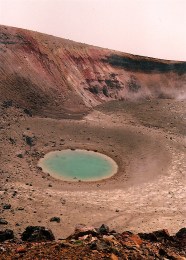
The hike: From the bus stop, backtrack down the main road for about 100m and you’ll see the hiking trail on your right. The trail starts off in a forested area, where you’ll clamber over exposed tree roots on the heavily traveled path. After about 40 minutes or so, the views will start to open up, and you’ll see the huge, smoldering peak directly in front of you. It looks very close, and indeed it is, but it’ll still take the better part of an hour to reach the crater rim. The vegetation thins out the higher you go, and the summit is not the place you want to be in a thunderstorm, so use common sense if the weather is bad. Once you reach the crater rim, turn left for the short climb to the high point. Marked by a rectangular stone pedestal, the summit offers wonderful views down to Lake Akan, as well as a bird’s eye view of the stinky, hissing, hell-like crater directly below. The conical peak of Akan-fuji towers just to the left of the crater, and on a clear day the peaks of the Hidaka mountains can be seen way off in the distance. From the summit, continue along the rim of the crater towards Onetto (オンネトー). The trail will quickly drop to a saddle at the foot of Akan-fuji. Climb the conical peak if you’ve still got energy and if it’s still relatively early in the day. Otherwise,keep descending on the path towards lake Onetto. You’ll soon enter a forest which becomes quite dense as you approach the lake. Just before reaching the end of the trail, you’ll find a flat, swampy area that looks like a stomping ground for bears, so make sure you have your bear bell with you. The trail ends at a gravel road. Turn right to reach the campground. You could turn left if you want to do the side trip to Yu-no-taki (湯の滝), a hot spring waterfall, but be warned – the free open-air bath has been dismantled in the name of environmental protection, so if you’re expecting a hot bath then you’ll be sorely disappointed. I wouldn’t recommend this side trip as the waterfall isn’t really that big and isn’t gushing out hot water either! Anyway, the campground charges for camping space and the water must be boiled before drinking, so make sure you’ve brought plenty of water with you from Akan-kohan. Walk through the campground and follow the trail that goes around the lake. Lake Onetto is phenomenally beautiful – the emerald green colors put the beaches of Okinawa to shame! About halfway around the lake you’ll find a trail junction on your left. This is the trail back to Meakan-onsen and it’s also an area with a fair number of bears. A late afternoon stroll through here without your bear bell is definitely an accident waiting to happen. It should take about 30 minutes or so to complete the loop back to the hot spring. There are two places to stay at Nonaka-Onsen. The youth hostel is looking a little worse for wear, and was completely booked when I visited, so I opted for the adjacent Kokumin-shukusha, which charges 7000 yen for 2 meals and has one of the best baths in all of Hokkaido. Click here for the website.
Special Note: As of August 2011, the trail to Me-akan is open. If any further volcanic activity becomes apparent, I will update this status. There’s still a lot of steam billowing out of a side vent near Akan-Fuji, so take care if the winds are blowing from across the crater.
When to go: This hike can be done from Golden Week to early October, when most of the snow is gone. The road to the trailhead is open all winter, so those with the right experience, equipment, and their own transport could also attempt this in the winter, but I would be very cautious on days with poor visibility and high winds. The road between Meakan hot spring and Onneto is popular with cross-country skiers and snowshoers.
Access: Please note that the bus from Akan-kohan to the trailhead has been abolished. The only way to get to the trailhead is by car, taxi, or hitching. From Kushiro (釧路) station, take a bus for Akan-kohan (阿寒湖畔) and get off at the last stop, which is a large bus terminal. Click here for the bus schedule. You can also take a bus from Mashu Station, but there are only 2 buses a day and they only run from July to October. Click here for that schedule.
Live web cam: Click here
Level of difficulty: 4 out of 5 (elevation change 789m).




 Hiking in Japan