Posted tagged ‘hiking’

Mt. Takatori (高取山)

August 1, 2012

Mt. Takatori is the site of Japan’s oldest mountaintop castle, and the hike takes you up, around, and through the ruins of the castle walls, with views of both the Yamato plain and the Omine mountain range. It makes for a great half-day excursion from Osaka or Nara cities.
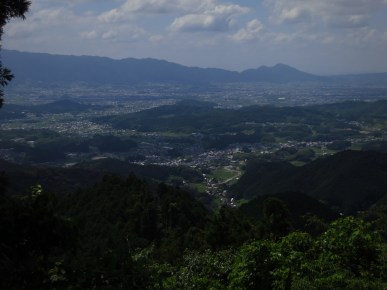
The hike: From Tsubosakayama station, exit the ticket gate and take the road running perpendicular to the station. Cross over the busy two-lane road, walk about 100 meters or so, and then turn right on the stone paved street running through the center of town. You’ll see a wooden signpost that says 高取城跡 5.0km. The next 20 minutes or so is a pleasant walk through a traditional Edo-era town that is surprisingly devoid of tourists. If this town were in Kyoto there would be thousands of tourists, so appreciate the beauty of the old buildings and lack of people. You’ll find a lot of distractions while marching up the main street, including some paper-mache cows on a side road on the right, followed by another brilliant display of elegantly dressed dragons on your left. Continue heading straight on the road out of town, as it starts to narrow and follow a river. A little further on, you’ll see a brown sign in white letters that says 俳人·阿波野青畝生家 150m pointing straight ahead. The road turns a bend before reaching a traditional bark-thatched structure housing a waterwheel. It’s worth crossing the stream and walking down to the rustic structure before heading up the paved road towards the trailhead. After passing by a public restroom on your left (your first and only chance to use the facilities), the road will turn into a hiking path and enter the forest. A few minutes on you’ll reach a junction with a sign pointing towards Sousenji (宗泉寺) Temple on your right. There are 88 different jizo statues scattered on the hillside behind the temple, and watch out for that vicious dog tied to the rope just to the right of the main temple gate. Anyway, after a quick look around, retrace your steps back to the junction and continue on the path that leaves the forest road and starts climbing up towards the ridge. Follow the signs that point towards Takatori-Shiroato (高取城跡) as the route follows a small stream and zigzags through the quiet woods. After 20 minutes of hiking you’ll reach a junction with a sign pointing towards 岩屋不動 on your right. You can visit this as a quick side trip if you’d like or continue on towards the summit. I didn’t bother checking it out, so please let me know if it’s interesting if you choose to explore it. Your next landmark will be a trail on your left marked by a stone monkey statue. This path apparently leads down to Asuka, one of the ancient burial centers of the Nara era. Ignore this trail and continue as the path starts to follow the ridge. After passing by a small lake on your left (which is just off the trail), you’ll soon see some signposts marking the foundations of some old castle gates. The castle complex was massive, taking up most of the mounainside when it was originally built. Your next landmark will be a path on your right marked for Kumini-Yagura (国見櫓), the remnants of an old watchtower. You should definitely take this trail as a sidetrip, since the views over the Yamato plain are second-to-none. It’s also a good place to take a break, since there are some moss-covered wooden logs to sit on. It should only take about 5 minutes to reach the lookout point. After admiring the scenery, retrace your steps back to the junction and turn right, following the signs towards the main castle area (本丸). A few hundred meters on, you’ll reach yet another junction marked for Hachiman-Guchi (八幡口), but ignore this trail for now and head to the 本丸. Once you reach the castle walls, keep climbing up until you can climb no more. On the far side of the highest castle area there is a lookout to the north, where you can see the Omine mountain range on a clear day. Take a rest here, as you’re at the highest point in the hike. Once you’ve regained your strength, backtrack to the Hachiman-Guchi junction and turn left down a set of wooden steps towards a forest road. Once your reach the road, follow the signs towards Hachiman Jinja (八幡神社), which climbs a series of steep log steps through the trees. If you’re tired of climbing, you can ignore this path and continue on the trail that bypasses this shrine to your immediate right. Either way both paths will meet up a short time later. The shrine is interesting as far as small secluded mountain shrines go, and there’s a small view of the valley below behind the shrine. Descend down the steep unmarked path in front of the shrine, which will soon meet up with the main path. Turn left here and keep following the signs towards Tsubosaka Temple (壺坂寺). You’ll cross the forest road a couple of times, but as long as you keep following the signage you’ll be ok. At one point you’ll reach a junction with 2 different signs pointing towards 壺坂寺. This is an important junction because if you go left then you’ll miss all of the good stuff. Take the path marked 五百羅漢遊歩道を経て壺坂寺, which, after a short climb, will start to descend through the dense forest. Be on the lookout for rock formations with Arhat statues carved into them. There are hundreds of ancient stone statues carved into the hillside. Some of them are easy to miss, so look for the white signboards with Chinese characters on them. Eventually you’ll loop around and meet up with the main path, which turns towards the right and descends to the paved road. Walk down the asphalt road for about 15 minutes and you’ll arrive at Tsubosaka temple, which is famous for a 10 meter tall Buddha statue. The temple costs 600 yen to enter, but is well worth a look around. If you don’t have the time or money, then you can continue on the trail that leaves just to the left of the bus stop at the end of the parking lot. This path drops down to a stream and follows it for about 30 minutes until meeting up with the main road back into town. Turn right when you hit the road and meander your way through the back streets towards the station, following the signs for 壺坂山駅.

When to go: This hike is most popular in autumn, when the leaves are ablaze with color. Spring is also a good time to check out the mountain cherry blossoms. Avoid the middle of summer during the intense heat, but early summer can be a good time to see wonderful greenery.

Access: This is one of the few hikes that is approachable directly from a train station. From Abenobashi (阿部野橋) station in Tennoji, take an express train on the Kintetsu line bound for Yoshino (吉野) and get off at Tsubosakayama (壺阪山) station. The train takes about 45 minutes or so from Osaka. Don’t take a limited express train because you’ll have to pay extra money and it really doesn’t save very much time.

Level of difficulty: 2 out of 5 (elevation change ~450m)

Distance: 11km (3 to 5 hours)

This slideshow requires JavaScript.

Mt. Seppiko (雪彦山)

June 4, 2012

Last updated: Feb 26, 2025

Mt. Seppiko is a collection of vertical crags located due north of Himeji city in Hyogo Prefecture. The cliff faces attract rock climbers from all over Japan, while the well-marked hiking path affords breathtaking views into the valley far below.

The hike: From the parking lot, head uphill, crossing the river on a metal bridge until reaching a collection of wooden bungalows. There’s a small campground on your left, and a shack on your right housing the caretaker of the facilities. There’s a box here where you can register your hiking intentions, which is an excellent idea if you’re out on your own. On the left side of the road, just adjacent to the bungalows, you’ll see a steep path heading into the forest via some wooden log steps. Take this trail and prepare yourself for a whirlwind of a climb up to the ridge. There’s really no place to go but up, following the switchbacks and fluorescent pink arrows up, over, and around some rock formations. After an hour of so you’ll reach Izumo Rock (出雲岩), an impressive mass of stone that is extremely popular with expert climbers. If you look up the rock face you’ll see countless rows of anchors bolted into the overhanging face. After passing by Izumo, the path becomes much tougher, as you nagivate through rock outcroppings with the assistance of ropes and chains. Your next rock formation is called Seri (せり岩), which has a jaw-dropping view of the southern half of Hyogo prefecture. The path here traverses through a tight gap in the rocks, and if you’re a bit muscular or heavy set, there’s a good chance you could become stuck. Take your day pack off and push it in front of you. This will make things a bit easier. If you can’t fit through this tight squeeze then simply walk over to the lookout point (見晴らしい岩) and head around to your left and you should find a trail that will bypass this rock. Once past Seri, it becomes a series of manageable rock climbs to the summit of Otenshou (大天井岳), the official target peak for the majority of hikers. Take a rest here and admire the views. From here, the trail drops off the back side of the peak, just behind the shrine. At first the going is easy but you’ll soon reach the top of a rock formation, where a chain will drape off the rocks to the right. Instead of taking the chain, head down the faint trail on the left, which is a much easier and safer alternative. Both trails meet up a little lower on the saddle, so take your pick. Once at the saddle, the path climbs and you’ll soon reach a junction, which is labeled with the signpost A-9. If you’re short on time, then take the trail to the right, which descends very steeply to the valley below. Otherwise, turn left here and stay on the ridge, following the sign that reads Shikagatsubo (鹿ヶ壷). The ridge is pretty gentle, especially considering what you’ve just been through. You next landmark will be at signpost B-4, where the trail splits towards 安富町. Instead of turning left here, go right, following the sign that says 三角点雪彦山. You’ll reach the top of the true summit of Mt. Seppiko in about 20 minutes, but there’s no view to speak of. Continue on the ridge, following the sign that says 峰山方面へ and you will arrive at another peak called Mt. Hokotate (鉾立山), which is the tallest peak on of Mt. Seppiko. Though the south is covered by trees, you’ll have an open view to the north, where you can see Mt. Hyonosen on a clear day. Take a breather here, because you’re about to descend very steeply to the valley below. 5 minutes after leaving the summit, you’ll reach a junction labeled B-8, where you should turn right. The path will ramble along the ridge before hanging a sharp turn at the next signpost (B-9), where it zigzags through a cedar forest to a stream far below. This stream will gradually grow in size the further down the gorge you get, and eventually you’ll reach a series of waterfalls (signpost B-13). The path becomes much more rockier, so be careful with your footing, especially if it’s been raining recently. A few minutes on, you’ll reach rainbow waterfall (虹ヶ滝), which is not signposted but makes a good place for a break. Soon after the waterfall you’ll reach a junction labeled A-14, where the trail from Mt. Otensho will come in from the right. This is where the path meets up from signpost A-9 high on the ridge. Ignore this path and drop down to the river, where you’ll need some creative footwork to cross over the river and climb steeply back up to a junction on the opposite bank of the stream. Follow the broad path that is signposted for  賀野神社, which passes through a beautiful section of deciduous forest that will surely be ablaze with color during the autumn. A few minutes on you’ll reach another junction called  大曲 (A-16). Turn right here and descend back to the river that you left earlier. The path can be difficult to pick up, so look for the pink arrows painted on the rocks and follow the faint outline of a path. A forest road used to come all the way up here a long time ago, and the last part of the path will follow the remainder of that road until reaching a huge concrete dam with some incredible pipework. This is what is known as an “open dam”, which was built not to contain the water but to save the valley from rocks and debris during a mudslide. I’m not sure if the dam could withstand an actual landslide, but you have to admit that it was a creative way for Hyogo Prefecture to use all that money from the central government. Anyway, go down the concrete stairs here and you’ll reach a paved road that will take you back to the parking lot where you started.

When to go: This hike can easily be done year round, but extra care should be taken in the winter, especially when there is snow on the ground. The rock faces can be incredibly slippery, so it’s best to avoid the place in wet weather. Autumn is probably the most scenic time to visit, but expect huge crowds if coming on a weekend.

Access: The bus to the trailhead was discontinued in 2010, so you really need your own transport to conveniently complete the hike. The bus, however, does run to within 5km of the start of the hike, so you could always try your luck hitching. From the north exit of Himeji station, take bus #51 bound for Maenoshō (前之庄) and get off at the last stop. From there, change to the community bus and get off at Teragochi (寺河内). From there it’s about a 90-minute walk to the trailhead. To search for the timetable for Maenoshō, click on the Shinki bus website and in the 発 field, paste 姫路駅 (北口) and in the 着 field, paste 前之庄 .

Level of difficulty: 4 out of 5 (elevation change 680m)

Distance: 6km (6 to 8 hours)

This slideshow requires JavaScript.

Maetake (前嵩)

May 29, 2012

Maetake is a pointy peak overlooking Kabira bay in the northwestern part of Ishigaki Island. It’s a good chance to see some jungle scenery without much effort and can be combined with a visit to nearby Kabira park.

The hike: If coming from Kabira, go past Yon bus stop on the main road and turn right when you see the blue billboard that says 島料理あたん亭 on the left side of the road. You’ll see a paved road with a chain across it just opposite this sign. Park your car or bicycle here, climb over the chain, and walk straight on the road. After about 10 meters you’ll see the ruins of an old building on your right, so keep walking straight and soon the road will start to narrow considerably and turn into a trail. Ignore the paved road on your right just before you enter the forest. After about 5 minutes, you’ll cross a log bridge (basically a tree that’s been cut in half and laid across a small stream). About 10 meters after crossing this log, the path will split, and you’ll see an old wooden sign propped up against an electrical pole. Turn right here and follow the path that goes next to the stream. The trail is easy to follow and crosses the stream a couple of times before climbing up to the ridge. It should take about 25 minutes of relatively easy climbing before reaching the ridge, where the path takes a sharp turn to the left and flattens out. Just where the path turns you’ll see a faint trail on your right which leads to the summit of Maetake. It’s pretty easy to miss, so if you soon arrive at an NHK antenna then you know you’ve gone too far. This narrow, slightly overgrown path climbs straight up the spine towards the summit and is incredibly slippery and muddy in wet weather. After 20 meters the path will appear to split, but if you look up and towards your right you’ll see a medium-sized boulder. Head up to the rock and just beyond you’ll see a rope dangling from a tree. Use this rope to help you climb up to the summit plateau, which is covered with 2-1/2 meter-high bamboo grass. You’ll literally need to swim through this mountain of grass to reach the top, but it’ll only take a few minutes. Once you reach the high point there are a couple of rocks you can stand on to get a view over the undergrowth. You’ll see Kabira peninsula stretched out before you, with Sukuji beach directly below. To your right you can see the rest of Kabira bay, with Mt. Omoto and Mt. Nosoko stretching out beyond. After you have admired the views, retrace your steps back to the junction and continue on the ridge to the NHK antenna. There are some good views between the trees, and the concrete makes a good place to take a break and eat some snacks. If you continue on this trail another 50 meters or so, you’ll reach another building housing a TV antenna. If you walk behind the building you can get great views of Kabira bay, which are unfortunately framed by power lines! All in all it should take anywhere from 30 to 45 minutes to reach the summit, which makes it a great afternoon or late morning hike.

When to go: This hike can easily be done year round, but bring plenty of water if hiking in the hot summer.

Access: The hike is a 2km walk from Kabira bay. If you’re staying at Iriwa Guesthouse in Kabira, then you can borrow their bicycle to get to the hike. Otherwise, the closest bus stop is called Yon (ヨーン) Buses bound for Kabira stop here, so just tell the driver you want to get off at Yon. Click here for the bus schedule.

Level of difficulty: 2 out of 5 (elevation change ~200m)

Distance: 4km (1-1/2 to 3 hours)

This slideshow requires JavaScript.

Hiking Shirts

May 20, 2012

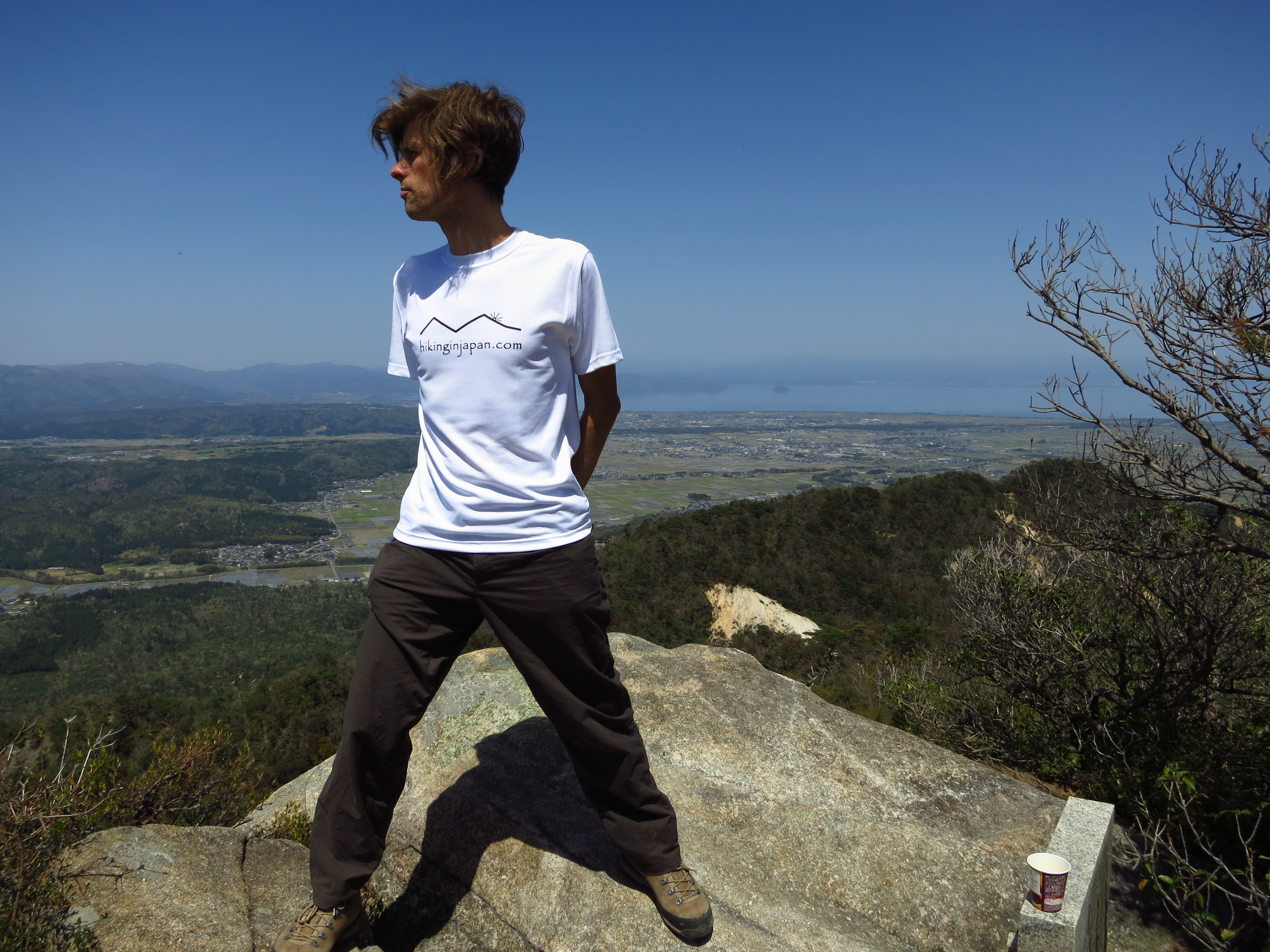
I’m pleased to announce that the official Hiking in Japan hiking shirts are now ready for purchase. The 100% polyester ‘quick dry’ short-sleeved shirts are both light-weight and incredibly comfy considering they’re not made from cotton.

They come in a variety of colors and each shirt has been hand-screened by Osaka based silk-screen artist Marlon Rivera.

The shirts are being sold for the incredibly reasonable price of 3000 yen (which includes shipping anywhere within Japan). Overseas orders please add 500 yen to cover international shipping.

Payment is accepted via either bank transfer (furikomi) or by well-concealed cash. We do things here the old-fashioned way and can’t be bothered with setting up a Paypal account or credit card transactions. Another option is to come to Osaka, meet up for a burrito, and get the shirt directly from me.

The sizes are somewhere between US and Japan sizes. The medium shirts will fit a skinny male up to 190cm tall. If you’ve got some muscles, a large size should suffice. Average size females should fit into a medium size quite easily, and if you’re skinny or short, a small size will probably do.

If you’re interested, then please send me a message letting me know your color preference and size, and I will send you my bank information.

This slideshow requires JavaScript.

Mt. Iino (飯野山)

May 14, 2012

Last updated: December 28, 2024

Mt. Iino, known to the locals as Sannuki-Fuji, is a non-volcanic symmetrical with commanding panoramic views. The ease of access and variety of paths make it a popular outing for both locals and tourists alike.

The hike: From the bus stop, cross under the overhead expressway and turn left, following the highway for a few minutes.  Turn right on a road that climbs through a neighborhood of houses until reaching the start of the path at the Yagaikatsudou Center (野外活動センター). From the center, you can either climb up the paved path right in front of you (signposted) or take the unmarked steep stone stairs on your left. Both paths meet up a little higher. After about 10 minutes of climbing, you’ll reach a junction at the 3rd stagepoint (三合目). Turn right here and follow the wide, gentle path as it circumnavigates the full circumference of the mountain. It’s virtually impossible to get lost, and the views will open up in gaps between the trees. There are plenty of signposts, and the stagepoints are clearly marked. Keep your eye out for feral cats as well, as there are about a dozen felines that make their home here. Just past the 7th stagepoint (七合目), you’ll see a path that crosses on your right. This leads down quite steeply back into town and is an alternative way off the peak (though there’s no public transport if you descend via this option). If you turn left here, however, you’ll climb up a shortcut to the summit that only takes 5 minutes. Don’t worry, though as the main path and this shortcut both meet on the summit, so take your pick of this one of the broader trail that continues straight. Once on the top, you’ll be greeted with a large shrine, a decorative stone etched with a famous poem from the late emperor Showa, and several dozen other hikers, depending on when you choose to climb. There’s plenty of space to spread out. Although the view is somewhat obstructed by trees, if you take a short side path marked おじょもの足跡・展望所 30m, it’ll lead to a wooden platform with a 180-degree panoramic view of the valley below. After admiring the views, retrace your steps to the summit and either take the unmarked path to your left or the unmarked trail to the right of the large stone summit marker. If heading on the left trail just to the left of the carved stone statue of Ebisu, then descend a few minutes to a junction. A steep trail shoots off into the forest on your left. This is a slight shortcut to the main trail, which you can take if you’re experiences. Otherwise, just continue straight.  Stay on either trail for about 20 minutes or so, and you’ll be back at the 3rd stagepoint (三合目), where you can retrace your steps back to the trailhead and bus stop. All in all it should take about 2 to 3 hours or so to complete the loop, depending on how many breaks you take.

When to go: This hike can easily be done all year round, but watch out for the heat and humidity of the summer. The autumn colors are brilliant, as is the lush greenery of early May. Winter is also a good option as the peak usually does not get snow.

Access: There are 3 different routes up the peak from 3 different sides, but if relying on public transport your only option is to climb the most popular route up the peak. If you have your own transport, then park near Marugame City Yagaikatsudou Center (野外活動センター) and hike in from there. From Marugame (丸亀) station on the JR Yosan line (40 minutes by Shiokaze limited express train from Okayama station), take a Marugame community bus bound for Mitani Danchi (三谷団地) and get off at Iinoyamatozanguchi (飯野山登山口). There are only 5 buses a day for the 25 minute ride to the trailhead. Click here for the schedule. You might find it easier to just take a taxi from Marugame station, which will cost about 2200 yen from Marugame station. If taking a taxi, ask the driver for his/her business card, which should have a phone number on it should you need to book a taxi for the return journey back to the station.

 Map: Click here

Level of difficulty: 2 out of 5 (elevation change ~400m)

Distance: 4.5km (2 to 3 hours)

This slideshow requires JavaScript.

Radiation in the Mountains: Q & A

April 8, 2012

The following is a translation of an interview conducted with Katsumi Shozugawa, an Associate Professor and Researcher at The University of Tokyo Graduate School of Arts and Sciences, which appeared in the January 2012 issue of Yama-To-Keikoku Magazine, a monthly outdoor magazine published in Japanese. This translation has been done with the consent of the magazine and should be of interest to hikers in Japan who can’t read Japanese. The opinions expressed here reflect those of Mr. Shozugawa and not of Yama-to-Keikoku or Hiking in Japan.

Question 1:  Aren’t the radiation levels in mountains streams high?

Recently we tested Karasugawa river (on Mt. Adatara) and found that above Karasugawa bridge radiation levels varied from 0.05 microsieverts/hour* to 0.312 microsierverts/hour. However, at the bridge level at the river embankment the readings were 0.184 and decreased to 0.176 at the surface of the river. From this we can see that because of wind and rain, soil or leaves containing radioactive cesium have been transported, the speed of which varies according to region. For this reason, over time the areas which have previously had a high air dose rate can fluctuate. In this way, due to the fact that environmental conditions are constantly changing, it’s difficult to accurately predict whether mountain streams have high or low levels of radiation.

Question 2: Are there any radiation hotspots in the mountains?

Yes there are.  This time approximately 0.02 microsieverts/hour was observed on a forest road at the edge of a gully. We also measured at the base of the gully and found readings nearly double what was found at the forest road. When you take a rest during your hike, it’s best to avoid these types of gullies where mud and runoff have accumulated, as well as areas with large piles of rain-transported foliage.

Question 3: Is it ok to take home fallen leaves or soil from the mountains?

It has been reported in the news that fallen leaves have contained a high level of contamination, but if you want to take home one leaf as a memento, it shouldn’t be a problem. However, you should refrain from taking away large quantities of foliage as well as rustling through large piles of fallen leaves.

Question 4: Since the snow season has arrived, what kind of radioactive effect will there be?

Since snow will cover the land, you won’t need to worry about flying radioactive particles or the risk of internal radiation exposure. In addition, snow has a shielding effect against radiation, depending on the density of the snow. We can expect a 30 to 40% reduction in radioactive emissions in compacted snow (such as those in groomed ski resorts). If the snow has accumulated over 1 meter in depth, however, then it is thought there will be a full shielding effect. Since fresh snowfall has a low risk of contamination, it should not be a problem to drink snowmelt.

Question 5: Is it ok to gather and eat mushrooms from the mountains?

There hasn’t been adequate testing, so you should not eat wild mushrooms gathered in the forest. In the mountains, there is a high likelihood for radioactive contamination of kinoko mushrooms, chestnuts, freshwater fish, river crabs, wild boar and such. Since the mountainous landscape is extremely diverse, even small changes in location can result in varying levels of contamination. Viewing wild mushrooms is ok, but you should refrain from picking and eating them.

Question 6: What should you do if you fall and injure yourself, getting dirt into your open wound?

There is a danger that radioactive materials attached to soil could directly enter your bloodstream, which is thought to be more dangerous than direct inhalation or drinking contaminated water. In order to decrease internal radiation exposure, wounds should be washed with water as quickly as possible. After washing, the wound should be wrapped with a bandage in order to prevent dust and dirt from reentering the wound. It is safer to use a hydrocolloid dressing (such as a kizu power pad) to help keep air out.

Question 7:  Is it safe to drink from the mountain streams and rivers?

Since radioactive cesium has a positive charge, it is easily bonded to clay particles containing a negative charge. Once this happens, it is thought that there is a low chance of these bound particles dissolving in water. This being the case, as long as Iodine 131 is not emitted, there shouldn’t be a worry of contamination of underground water sources. Since there is a danger of contamination in the dirt riverbeds, you should avoid ingesting dirt particles when drinking water from streams. Instead, water should be filtered with a portable water filter.

Question 8: Are there any precautions you should take after finishing your hike?

At the trailhead, please clean off all dirt that has stuck to hiking boots, clothing, and your backpack. When doing this, be sure not to inhale any of the brushed off dust. Since volcanic soil can contain especially strong acids and alkaline metals, you should wash off your boots immediately after finishing your hike. If you don’t, the rubber and leather can deteriorate rather quickly. Regardless of whether there is radioactive contamination or not, it’s my recommendation to promptly clean off everything before returning home.

*Read here for more information regarding measurements of radiation.

Nosoko Maapee (野底マーペー)

March 26, 2012

Mt. Nosoko is a volcanic, helmet-shaped mountain situated in the northeastern part of Ishigaki Island. The views from the rocky summit are some of the best on the entire island.

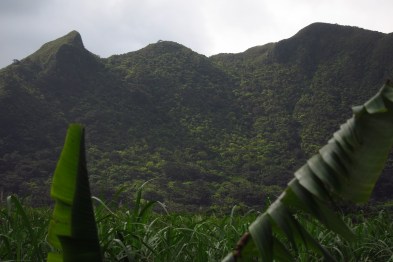
The hike: From Shimoji (下地) bus stop, head past the elementary school and turn right when you get to a paved road with a small white sign reading “野底マーペ登山道”. The road passes by some sugarcane fields with a head-on view of Mt. Nosoko before reaching a junction. Turn right, following the “マーペー” around the bend and over the river. The trailhead is on your left, just after you cross the bridge. It should take about 10 minutes to reach this point. Look for the sign that reads “野底マーペー登山道入口”. Turn left at the sign to enter the jungle. You’ll soon cross an area with a leaning chain link fence on your right and will cross a stream using a series of cinder blocks. Just past here, the trail makes a sharp right turn (don’t cross over the white chain) and starts climbing towards the peak. The trail is pretty easy to follow, and you can always look for the red tape on the trees if you’re unsure. After a few minutes of climbing you’ll find a downed tree draping across the path. Slide under the tree and continue advancing on the root-infested trail. Soon you’ll run into areas with red clay that becomes quite slippery when damp. Use the ropes to help you if you’re unsure of your footing. After 15 minutes or so, the trail will cut towards the right, where you can follow the white “登山” signs painted with red arrows. After a bit more climbing the trail will start to traverse to the other side of the peak, past some incredibly large boulders. Don’t try to climb the rocks to get a view because you’ll get plenty of views at the top. After a few more minutes, you’ll reach a junction. This is the turnoff towards the paved road where lazy hikers park for a shortcut to the top. The path is marked as “林道”, but ignore it and head straight on the “山頂” path. From here the climbing gets much steeper but it will also start to open up a bit. You should reach the rocks at the summit plateau in about 10 minutes or so. Scramble up to the rocks and you’ll have an unobstructed panoramic view of the entire island. After taking in the views, retrace your steps back to the trailhead.

When to go: This hike can easily be done year round, but watch out for mud during or just after the rain. Also, make sure you wear long pants to keep the ticks (and leeches) away. Hiking shoes are a must as well, since your toes will likely turn into a bloody mess if using sandals because of all  the exposed tree roots.

Access: From Ishigaki Bus Terminal, take the 10:45am 西方面 bus (11:25am bus from Kabira) bound for Ibaruma (伊原間) and ask the driver to let you off at “Nosoko Maapee tozanguchi no chikaku” (near Mt. Nosoko trailhead). If the driver doesn’t know, the turnoff is between Shimoji and Kanegusuku bus stops. You can get off at Shimoji (下地) and walk from there if you’re not sure. The bus arrives at Shimoji at 12:00 noon, and the only bus back into town leaves at 1pm, which means you won’t have enough time to make it up and back before that bus. Never fear, because it’s incredibly easy to hitch on the island. Catch a ride to Yonehara and you can catch a bus from there back into town, or call an expensive cab if you don’t feel comfortable riding with someone you don’t know.

Level of difficulty: 3 out of 5 (elevation change ~250m)

Distance: 4km (1-1/2 to 3 hours)

This slideshow requires JavaScript.

Pinaisaara Waterfall (ピナイサーラの滝)

March 15, 2012

Pinaisaara waterfall is an exciting kayak/hike combination on Iriomote Island, one of Japan’s best preserved wilderness areas. You may even get to see a Crested Serpent Eagle flying through the mangrove trees.

The hike: From the boat landing, kayak up the river, making sure you stay on the right fork of the river when it meets Funaura bay. From here, it should take about 15 to 20 minutes of easy kayaking to reach the start of the hike. If you’ve come by yourself, then look for a place to tie up your boat on the right side of the river, before the river turns into rocks and rapids. Be sure to store your paddle inside your kayak and put your life jacket in a tree so you can find your boat later. Better yet, take a picture of your kayak so you can remember what it looks like! Once you exit the boat, you have 2 options. If you turn left and follow the stream upriver, you can get to the base of Pinasaara waterfall. If you turn right and climb up to the ridge, you can climb to the top of the falls. I recommend climbing to the top first, and then visit the base of the falls for a swim before paddling back to the start. Enter the jungle from the boat landing and turn right, following the trail for a few meters before it starts the short but steep climb to the ridge. The trail is completely unmarked and can be difficult to follow (I think this is done on purpose in order for the guides to justify their existence).  You should reach the ridge after about 10 minutes of strenuous climbing. At one point you’ll reach a large rock formation, but there’s a rope here to assist you in the ascent. Just past this the trail will flatten out and turn towards the left. After a few minutes you’ll cross a stream and reach the top of a crest, where you can hear the waterfall. There’s a faint trail to the right, but ignore this and take the trail to your left marked with a white buoy tied to a tree. It’s a steep 2-minute descent to the river, which is at the top of the waterfall. In order to look down on the waterfall and out to sea, you’ll need to cross the river, which can be really tricky. Just to your left you’ll see a very small waterfall that stretches the length of the river. At the base of that fall the water is shallow and the river bed is flat, so this is where you’ll want to cross. Upstream seems safer, but there’s no way of getting up there. Once you cross, head downstream and around towards the right to the top of the cliff. It seems like it would be easier to just stay on dry land and walk along the flat rocks on your right, but be careful because they are extremely slippery. If you’re not sure where to go, then just wait for a guided tour to come along and watch how the guide crosses the river. After admiring the views, retrace your steps back down to the river and continue upstream. The path can be a bit tricky to find, so when in doubt stick to the river until you end up crossing a portion of it. From here the track will climb up on the right bank of the river, away from the shore. The best course of action is to follow the scuff marks on the rocks. They’re the best indication of where to go. After about 10 minutes you’ll reach the base of the falls, so take a break here and enjoy the swim (if the water’s not too cold). After this you can backtrack to your kayak and paddle back to civilization. All in all it should take anywhere from 3 to 5 hours to do the entire trip, depending on how fast you can kayak and how long you rest/swim.

When to go: This hike can be done year round, but summer is the best season if you want to go swimming at the base of the waterfall. Winter can be just as rewarding, with fewer people and a better chance to see the waterfall at full strength.

Access: Although during low tide this hike can be done without a boat, the best way to appreciate the splendor of the place is to get to the start of the hike by kayak. 99% of the people join a guided tour, but it’s not necessary if you have a little experience with kayaking. Mariudo Guesthouse can rent you a kayak only (without a guide) for ¥4000. They’ll drop you off and pick you up, and will also give you a basic map. This is a great place to stay on the island, because the food is good, the staff are knowledgable, and they have a fantastic selection of tours. If you’re not comfortable with kayaking, you can always join their full-day guided tour for ¥8000, which includes the guide, lunch, and kayaks. Please note that these were the prices back in 2012 and they may have increased, so please inquire with the staff.

Level of difficulty: 2 out of 5 (elevation change ~100m)

Distance: 4km by kayak, 2km walking (3 to 5 hours)

This slideshow requires JavaScript.

Mt. Omoto (於茂登岳)

March 1, 2012

Mt. Omoto is not only the highest peak in Okinawa Prefecture, but also one of the most challenging hikes on Ishigaki island.

Warning: As of March 2012, the trail is officially closed to hikers, but that doesn’t stop people from climbing the peak. The path is overgrown in places and extremely slippery, so it should not be attempted by those without much hiking experience. Also, please don’t hike in sandals, as the peak has a fair number of venomous pit vipers and leeches.

The hike: From the bus stop, walk on the road about 20 meters in front of you (behind you if coming from Kabira) and turn left on the paved road with the overhead sign that reads Mt. Omoto 1.7km. Stay on this paved road for about 20 minutes, passing some greenhouses on your left. Just past the greenhouses, the road splits, and you’ll see a sign pointing towards the right fork that says 於茂登山 登山道. Turn right here and the road turns to gravel. Follow this to the end and you’ll arrive at the trailhead. The path is currently blockaded, but step around the cones and turn left. The path will soon arrive at an area that has been washed out, but there are steps built into the hillside to easily navigate past on the left.  Continue on the path for 5 more minutes and you’ll reach a grave that says 大御岳ぬ清水. Veer left at the tombstone and cross the small stream using the log bridge. The path will meet up with a narrow river and follow the right side for a while. Follow the tape marks and you should be ok.  You’ll soon see a sign reading 頂上まで 約40分. The signpost is turned 90 degrees and is barely hanging onto the tree. The trail heads towards the right and up some stairs, paralleling the river. Shortly you’ll come across a downed tree in the middle of the trail. Instead of climbing over the tree, head down towards the river bank and around. Just past this the trail will appear to end, but look on the other side of the river and you’ll see the red tape. Cross the river using any rocks that seem stable. Just on the other side of the river you’ll see a blue and tan sign that reads 滝. Drop your pack here and head left for 2 minutes, where you’ll come to a beautiful waterfall. After taking a few photos, retrace your steps back to the junction and continue climbing, this time on the left bank of the river. The trail here starts to become a bit overgrown because most hikers go up to the waterfall and back. Just a few meters on, you’ll see a tree on the right side of the trail with red paint that says “No. 10”. The path is a bit unclear here, but take the trail just to the left of this tree. Soon you’ll reach an area that was previously washed out, with a large concrete retaining wall on the right side of the trail. Pass through this area and after a few minutes you’ll reach a sign that says 最後の給水ポイントです. Backtrack 3 steps and you’ll see a small stream with some blue cups hanging on a rock. This is your last chance to fill up on water, so take a well-deserved break here. After this sign, the trail starts climbing rather steeply towards the ridge, and the views will really start to open up. If it’s been raining then you’ll likely get soaked from head to toe from swimming through the brush. The path becomes more constricted the higher you climb, but it’s pretty easy to tell where you need to go. After 10 minutes or so you’ll see a yellow sign that says 頂上まで 約10分. Just past this sign you’ll reach a clearing on your left. At the top of this clearing is your first antenna, but there’s no need to go up there. Continue straight and the trail continues for a few minutes, where you’ll reach a signposted junction. Turn left to reach the summit (頂上), and go right to a lookout point (ダム展望). Take the left fork to the summit for now, since you can always go to the lookout on your way down. After a couple of more minutes you’ll suddenly pop out of the forest and come face-to-face with a giant TV antenna! Turn left here and you’ll reach the true summit after about 30 seconds. You’ll be completely surrounded by tall bamboo grass, but if you climb the boulder directly behind the summit marker then you can have an incredible panoramic view of the entire island. When you finish admiring the views, simply retrace your steps back to the trailhead, taking great care not to slip and fall on the way down. The path is absolutely treacherous in the rain as the rather large lacerations on my butt can attest to. All in all it should take anywhere from 90 minutes to 2 hours to reach the top, depending on how many breaks you take.

When to go: This hike can be done year round, but be prepared for a lot of rain if hiking in the winter. Bring plenty of water and sun protection if hiking in the summer, since it’s a long, sweaty climb. October is a good time to go, with cooler temperatures and less chance of typhoons ravaging the island. Click here for a great comprehensive English guide to Ishigaki Island, including an alternate description of this hike.

Access: From Ishigaki Bus Terminal, take the Yonehara Campground bus line (米原キャンプ場線) bound for Kabira (川平) and tell the driver you want to get off at Omoto bus stop (於茂登). The bus takes about 45 minutes and there are only 2 buses in the morning (one at 8:30am and the other at 9:30am). If you’re staying in Kabira then there are 2 buses in the morning on the Yonehara line bound for the bus terminal (one leaving at 10:10am and the other at 11:10am) You can pick up a copy of the bus schedules at the Tourist Information Center at the airport.  Click here for the bus schedule.

Level of difficulty: 4 out of 5 (elevation change ~400m) Experienced hikers only.

Distance: Approx. 7km (3 to 5 hours)

This slideshow requires JavaScript.


Mt. Mashu (摩周岳)

February 6, 2012

Perched on the shores of a stellar volcanic lake, Mt. Mashu offers a chance to experience a taste of the Hokkaido backcountry without a huge climb to get there. It may also offer your best opportunity to spot the elusive Japanese brown bear.

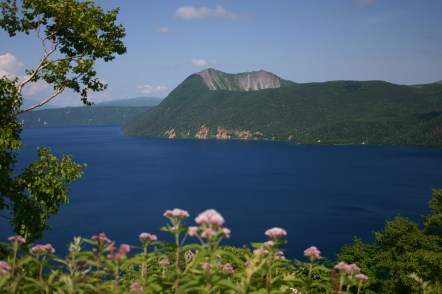
The hike: The trail starts at the end of the massive parking lot, just beyond the toilets. Look for the sign that says 摩周岳登山口. Don’t forget to write your details in the trail register located just below the signpost. The trail starts with a long descent to a saddle, with outstanding views of Lake Mashu on your left, framed nicely in the foreground by some photogenic wildflowers. From here, the trail starts a series of gentle climbs, followed by some long, gradual descents. There are signposts spaced evenly throughout the entire hike showing distances, which you can used to judge your pace. The trail really doesn’t fully pop out of the treeline until around the halfway point. When you see the signpost that reads “摩周岳3.3km”, the trail will start to open up a bit. Be careful on this next section, because at the crest of the next hill is where I saw two bears, right in the middle of the trail! Luckily it was on the return trip, so I could spot them from a very long way away. Fortunately, they escaped into the forest when they heard my bell, so please make sure you carry one. If you don’t have one, then the hostel owner will probably let you borrow his. Your next landmark will be a trail junction for Mt. Nishibetsu (西別岳). This is a good place for a break, because the steepest part of the hike now awaits. Ignore this junction and continue to the left for the final 1.9km push to the summit. The trail will start to become quite steep as you climb towards the crater rim. Keep climbing, and after an hour or so you’ll find yourself sitting on top of the bald, rocky top of Mt. Mashu. The highest point on the ridge is directly in front of you, but the ridge is much too treacherous to proceed any further. You’ll have an awe-inspiring panoramic view of the entire lake, as well as nearby Mt. Nishibetsu. If visibility is really good, you should also be able to see Mt. Shari and the peaks of Shiretoko National Park. After admiring the views, retrace your steps all the way back to the trailhead, and drop by the visitor’s center to eat some ice cream or warm noodles. It should take anywhere from 4 to 6 hours to complete the hike, depending on how many breaks you take. Bring plenty of water in the summer, because there are no water sources on the entire trail.

When to go: This hike can be done from late April to mid-October, when the buses to Lake Mashu are running. If going early or late in the season, be prepared for a lot of snow and perhaps some hungry bears. Be careful of horseflies if hiking in August and whatever you do, don’t forget your bear bell!

Access: From Mashu station (摩周駅), take a bus bound for Mashu Daiichi Tenboudai (摩周湖第1展望台) and get off at the last stop. Please note that between July 16th and October 10th you’ll need to buy a 1-day bus pass just to get on the bus. It’ll set you back 1500 yen, even if you’re only going up to the lake and back. It’s a good value if you plan on seeing other sites, but if not, then consider staying at Mashu Youth Hostel and just hitching up and back from the lake like I did. Catching a ride should be easy, since there’s only 1 road to the top. Another option would be just to take the regular non-tourist bus between April 23rd and July 15th. Click here for the bus schedule.

Live web cam: Click here

Level of difficulty: 2 out of 5 (elevation change 320m)

Distance: 14.4km (4 to 6 hours)

This slideshow requires JavaScript.