Archive for the ‘Archive’ category

Pinaisaara Waterfall (ピナイサーラの滝)

March 15, 2012

Pinaisaara waterfall is an exciting kayak/hike combination on Iriomote Island, one of Japan’s best preserved wilderness areas. You may even get to see a Crested Serpent Eagle flying through the mangrove trees.

The hike: From the boat landing, kayak up the river, making sure you stay on the right fork of the river when it meets Funaura bay. From here, it should take about 15 to 20 minutes of easy kayaking to reach the start of the hike. If you’ve come by yourself, then look for a place to tie up your boat on the right side of the river, before the river turns into rocks and rapids. Be sure to store your paddle inside your kayak and put your life jacket in a tree so you can find your boat later. Better yet, take a picture of your kayak so you can remember what it looks like! Once you exit the boat, you have 2 options. If you turn left and follow the stream upriver, you can get to the base of Pinasaara waterfall. If you turn right and climb up to the ridge, you can climb to the top of the falls. I recommend climbing to the top first, and then visit the base of the falls for a swim before paddling back to the start. Enter the jungle from the boat landing and turn right, following the trail for a few meters before it starts the short but steep climb to the ridge. The trail is completely unmarked and can be difficult to follow (I think this is done on purpose in order for the guides to justify their existence).  You should reach the ridge after about 10 minutes of strenuous climbing. At one point you’ll reach a large rock formation, but there’s a rope here to assist you in the ascent. Just past this the trail will flatten out and turn towards the left. After a few minutes you’ll cross a stream and reach the top of a crest, where you can hear the waterfall. There’s a faint trail to the right, but ignore this and take the trail to your left marked with a white buoy tied to a tree. It’s a steep 2-minute descent to the river, which is at the top of the waterfall. In order to look down on the waterfall and out to sea, you’ll need to cross the river, which can be really tricky. Just to your left you’ll see a very small waterfall that stretches the length of the river. At the base of that fall the water is shallow and the river bed is flat, so this is where you’ll want to cross. Upstream seems safer, but there’s no way of getting up there. Once you cross, head downstream and around towards the right to the top of the cliff. It seems like it would be easier to just stay on dry land and walk along the flat rocks on your right, but be careful because they are extremely slippery. If you’re not sure where to go, then just wait for a guided tour to come along and watch how the guide crosses the river. After admiring the views, retrace your steps back down to the river and continue upstream. The path can be a bit tricky to find, so when in doubt stick to the river until you end up crossing a portion of it. From here the track will climb up on the right bank of the river, away from the shore. The best course of action is to follow the scuff marks on the rocks. They’re the best indication of where to go. After about 10 minutes you’ll reach the base of the falls, so take a break here and enjoy the swim (if the water’s not too cold). After this you can backtrack to your kayak and paddle back to civilization. All in all it should take anywhere from 3 to 5 hours to do the entire trip, depending on how fast you can kayak and how long you rest/swim.

When to go: This hike can be done year round, but summer is the best season if you want to go swimming at the base of the waterfall. Winter can be just as rewarding, with fewer people and a better chance to see the waterfall at full strength.

Access: Although during low tide this hike can be done without a boat, the best way to appreciate the splendor of the place is to get to the start of the hike by kayak. 99% of the people join a guided tour, but it’s not necessary if you have a little experience with kayaking. Mariudo Guesthouse can rent you a kayak only (without a guide) for ¥4000. They’ll drop you off and pick you up, and will also give you a basic map. This is a great place to stay on the island, because the food is good, the staff are knowledgable, and they have a fantastic selection of tours. If you’re not comfortable with kayaking, you can always join their full-day guided tour for ¥8000, which includes the guide, lunch, and kayaks. Please note that these were the prices back in 2012 and they may have increased, so please inquire with the staff.

Level of difficulty: 2 out of 5 (elevation change ~100m)

Distance: 4km by kayak, 2km walking (3 to 5 hours)

This slideshow requires JavaScript.

Mt. Omoto (於茂登岳)

March 1, 2012

Mt. Omoto is not only the highest peak in Okinawa Prefecture, but also one of the most challenging hikes on Ishigaki island.

Warning: As of March 2012, the trail is officially closed to hikers, but that doesn’t stop people from climbing the peak. The path is overgrown in places and extremely slippery, so it should not be attempted by those without much hiking experience. Also, please don’t hike in sandals, as the peak has a fair number of venomous pit vipers and leeches.

The hike: From the bus stop, walk on the road about 20 meters in front of you (behind you if coming from Kabira) and turn left on the paved road with the overhead sign that reads Mt. Omoto 1.7km. Stay on this paved road for about 20 minutes, passing some greenhouses on your left. Just past the greenhouses, the road splits, and you’ll see a sign pointing towards the right fork that says 於茂登山 登山道. Turn right here and the road turns to gravel. Follow this to the end and you’ll arrive at the trailhead. The path is currently blockaded, but step around the cones and turn left. The path will soon arrive at an area that has been washed out, but there are steps built into the hillside to easily navigate past on the left.  Continue on the path for 5 more minutes and you’ll reach a grave that says 大御岳ぬ清水. Veer left at the tombstone and cross the small stream using the log bridge. The path will meet up with a narrow river and follow the right side for a while. Follow the tape marks and you should be ok.  You’ll soon see a sign reading 頂上まで 約40分. The signpost is turned 90 degrees and is barely hanging onto the tree. The trail heads towards the right and up some stairs, paralleling the river. Shortly you’ll come across a downed tree in the middle of the trail. Instead of climbing over the tree, head down towards the river bank and around. Just past this the trail will appear to end, but look on the other side of the river and you’ll see the red tape. Cross the river using any rocks that seem stable. Just on the other side of the river you’ll see a blue and tan sign that reads 滝. Drop your pack here and head left for 2 minutes, where you’ll come to a beautiful waterfall. After taking a few photos, retrace your steps back to the junction and continue climbing, this time on the left bank of the river. The trail here starts to become a bit overgrown because most hikers go up to the waterfall and back. Just a few meters on, you’ll see a tree on the right side of the trail with red paint that says “No. 10”. The path is a bit unclear here, but take the trail just to the left of this tree. Soon you’ll reach an area that was previously washed out, with a large concrete retaining wall on the right side of the trail. Pass through this area and after a few minutes you’ll reach a sign that says 最後の給水ポイントです. Backtrack 3 steps and you’ll see a small stream with some blue cups hanging on a rock. This is your last chance to fill up on water, so take a well-deserved break here. After this sign, the trail starts climbing rather steeply towards the ridge, and the views will really start to open up. If it’s been raining then you’ll likely get soaked from head to toe from swimming through the brush. The path becomes more constricted the higher you climb, but it’s pretty easy to tell where you need to go. After 10 minutes or so you’ll see a yellow sign that says 頂上まで 約10分. Just past this sign you’ll reach a clearing on your left. At the top of this clearing is your first antenna, but there’s no need to go up there. Continue straight and the trail continues for a few minutes, where you’ll reach a signposted junction. Turn left to reach the summit (頂上), and go right to a lookout point (ダム展望). Take the left fork to the summit for now, since you can always go to the lookout on your way down. After a couple of more minutes you’ll suddenly pop out of the forest and come face-to-face with a giant TV antenna! Turn left here and you’ll reach the true summit after about 30 seconds. You’ll be completely surrounded by tall bamboo grass, but if you climb the boulder directly behind the summit marker then you can have an incredible panoramic view of the entire island. When you finish admiring the views, simply retrace your steps back to the trailhead, taking great care not to slip and fall on the way down. The path is absolutely treacherous in the rain as the rather large lacerations on my butt can attest to. All in all it should take anywhere from 90 minutes to 2 hours to reach the top, depending on how many breaks you take.

When to go: This hike can be done year round, but be prepared for a lot of rain if hiking in the winter. Bring plenty of water and sun protection if hiking in the summer, since it’s a long, sweaty climb. October is a good time to go, with cooler temperatures and less chance of typhoons ravaging the island. Click here for a great comprehensive English guide to Ishigaki Island, including an alternate description of this hike.

Access: From Ishigaki Bus Terminal, take the Yonehara Campground bus line (米原キャンプ場線) bound for Kabira (川平) and tell the driver you want to get off at Omoto bus stop (於茂登). The bus takes about 45 minutes and there are only 2 buses in the morning (one at 8:30am and the other at 9:30am). If you’re staying in Kabira then there are 2 buses in the morning on the Yonehara line bound for the bus terminal (one leaving at 10:10am and the other at 11:10am) You can pick up a copy of the bus schedules at the Tourist Information Center at the airport.  Click here for the bus schedule.

Level of difficulty: 4 out of 5 (elevation change ~400m) Experienced hikers only.

Distance: Approx. 7km (3 to 5 hours)

This slideshow requires JavaScript.


Mt. Mashu (摩周岳)

February 6, 2012

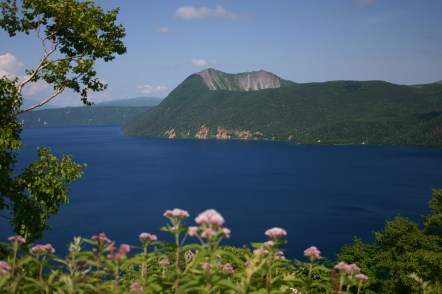
Perched on the shores of a stellar volcanic lake, Mt. Mashu offers a chance to experience a taste of the Hokkaido backcountry without a huge climb to get there. It may also offer your best opportunity to spot the elusive Japanese brown bear.

The hike: The trail starts at the end of the massive parking lot, just beyond the toilets. Look for the sign that says 摩周岳登山口. Don’t forget to write your details in the trail register located just below the signpost. The trail starts with a long descent to a saddle, with outstanding views of Lake Mashu on your left, framed nicely in the foreground by some photogenic wildflowers. From here, the trail starts a series of gentle climbs, followed by some long, gradual descents. There are signposts spaced evenly throughout the entire hike showing distances, which you can used to judge your pace. The trail really doesn’t fully pop out of the treeline until around the halfway point. When you see the signpost that reads “摩周岳3.3km”, the trail will start to open up a bit. Be careful on this next section, because at the crest of the next hill is where I saw two bears, right in the middle of the trail! Luckily it was on the return trip, so I could spot them from a very long way away. Fortunately, they escaped into the forest when they heard my bell, so please make sure you carry one. If you don’t have one, then the hostel owner will probably let you borrow his. Your next landmark will be a trail junction for Mt. Nishibetsu (西別岳). This is a good place for a break, because the steepest part of the hike now awaits. Ignore this junction and continue to the left for the final 1.9km push to the summit. The trail will start to become quite steep as you climb towards the crater rim. Keep climbing, and after an hour or so you’ll find yourself sitting on top of the bald, rocky top of Mt. Mashu. The highest point on the ridge is directly in front of you, but the ridge is much too treacherous to proceed any further. You’ll have an awe-inspiring panoramic view of the entire lake, as well as nearby Mt. Nishibetsu. If visibility is really good, you should also be able to see Mt. Shari and the peaks of Shiretoko National Park. After admiring the views, retrace your steps all the way back to the trailhead, and drop by the visitor’s center to eat some ice cream or warm noodles. It should take anywhere from 4 to 6 hours to complete the hike, depending on how many breaks you take. Bring plenty of water in the summer, because there are no water sources on the entire trail.

When to go: This hike can be done from late April to mid-October, when the buses to Lake Mashu are running. If going early or late in the season, be prepared for a lot of snow and perhaps some hungry bears. Be careful of horseflies if hiking in August and whatever you do, don’t forget your bear bell!

Access: From Mashu station (摩周駅), take a bus bound for Mashu Daiichi Tenboudai (摩周湖第1展望台) and get off at the last stop. Please note that between July 16th and October 10th you’ll need to buy a 1-day bus pass just to get on the bus. It’ll set you back 1500 yen, even if you’re only going up to the lake and back. It’s a good value if you plan on seeing other sites, but if not, then consider staying at Mashu Youth Hostel and just hitching up and back from the lake like I did. Catching a ride should be easy, since there’s only 1 road to the top. Another option would be just to take the regular non-tourist bus between April 23rd and July 15th. Click here for the bus schedule.

Live web cam: Click here

Level of difficulty: 2 out of 5 (elevation change 320m)

Distance: 14.4km (4 to 6 hours)

This slideshow requires JavaScript.

Mt. Odake (大岳)

November 7, 2011

Mt. Odake, which translates as Big Peak, is a rocky outcrop perched high on the ridge in the Okutama region of Tokyo. The views of Tokyo on a clear winter night from neighboring Mitake are a must-see and the views of Fuji are impressive when the cloud isn’t in.

The hike: From the top of the cable car, head left on the concrete path through an archway that says “御岳山へようこそ”. The route starts out quite flat before arriving at the small village, where it meanders a bit past a thatched-roof house and a youth hostel. Make sure you follow the signs that point towards 御岳山 and you should be ok. A little further on, the road will split in half, with an insanely steep slope branching off to the right. You’ll see a sign posted in English for “Rock Garden”, so kick-step your way up the muscle-burning road to the main gate of the temple. Along the way, you’ll pass by a couple of restaurants and souvenir shops. The udon noodles here are famous for their unique texture and green color, so consider having an early lunch if you’re in the mood. (I had no problems being served at 10:30 in the morning). Climb the stairs, go through the main gate of the shrine, and turn left, following the signs for 長尾平. At the time of writing, the path to the shrine was under construction, so you’ll be detoured to the right up an incredibly steep concrete road, where you’ll pop out just in front of the main shrine building. There’s a statue of a warrior on a white horse here, and that’s the landmark you want to search for. After a quick prayer, descend the staircase just to the right of the statue (if facing the statue that is), and you’ll see a toilet and concrete forest road, as well as a path signposted for 長尾平. The steep path was under repair during the autumn of 2011, but the short drop will connect with the main forest road/path after a couple of minutes. Turn right as soon as you hit this forest road and you’ll soon see a rest area on your left with some drink machines, picnic tables, and a shop selling snacks. If you walk down along this path for about 50 meters you’ll find some toilets and a nice view of Mt. Odake on your right and Tokyo on your left. Anyway, keep walking on the forest road and, for now, ignore the trail that branches off towards the left towards Rock Garden. A little further on you’ll find another trail junction, but instead of turning left, head on the upper path on your right towards Oku-no-in (奥ノ院). The trail will more than likely be deserted if you’re hiking during the week, as the majority of people stick to the gorge at Rock Garden. The cedar trees here are all mysteriously labeled with numbers, but the path is really easy to follow and the ground cover thin, exposing a vast network of tree roots. Keep clambering over the roots, past an exposed area with chains, and soon you’ll reach a trail junction marked 奥ノ院・鍋割山. You can either turn right here past the small shrine, or continue going straight and making a sharp right turn after about 5 meters. Whatever you do, don’t turn left and start descending steeply into the valley! The path is a bit difficult to pick up, so make sure you’re climbing instead of descending. A little past this tricky area you’ll reach another junction, with a trail on your left marked 大岳(巻道). You can take either path here, as they both meet a little further on. The  巻道 is much easier, as it skirts the base of 鍋割山 before descending back to the main forest road you left earlier in the hike. When you reconnect with this road, turn right and start the steep climb towards the mountain hut. There are a few exposed areas with chains and the path becomes much rockier, so take care of your footing. Eventually you’ll reach a mountain hut on your left and a rustic shrine on your right. There’s a toilet here, and this is a good place for a break before the final push to the summit. Walk up to the shrine and take the path just to the left (marked 大岳山頂) which zigzags its way up to another really rocky area. Take extreme care in rainy or misty weather, as the boulders can become quite slippery. After a tough 10-minute scramble, you’ll pop out on the summit of Mt. Odake, where the conical shape of Mt. Fuji will float above the clouds on the horizon. Or not, depending on what kind of mood she’s in. I caught a glimpse of Japan’s highest peak just before she hid behind the cloud. From the summit, you can continue on the ridge down to Oku-tama, but be warned that it’s a long, 3-4 hour hike. A better option would be to head back to Mitake via the Rock Garden path. Retrace your steps back to where you came, and turn right at the junction marked 御岳・岩石園. The trail will descend to a scenic valley with a couple of spectacular waterfalls. At the first shelter you come to, follow the sign written in English to Ayahiro waterfall. It’s a short, quick drop to an awe-inspiring cove of eerie rock formations and tumbling water. This is a great place to while away a few hours contemplating life (if you haven’t come here on the weekend with half of Tokyo that is). Continue descending through the gorge, taking care on the numerous river crossings. About halfway down you’ll come across a rest area with a toilet. Several minutes past this, the route will climb up towards an immense rock formation called Tengu-Iwa, where you’ll find a junction. Drop the pack here, and prepare for the adrenaline rush. First, take the path marked for Nanayo waterfall. The no-nonsense trail plummets down the valley via a never-ending array of metal stairs. Descend carefully, and after a few minutes you’ll reach the first waterfall. This area is extremely slippery even with a good pair of hiking boots on, and if you’re not careful you could tumble over the waterfall. You’re actually in the middle of a tiered waterfall, but you’ll have a great view of the tumbling water if you make your way over to the right. The path continues down from here (not sure if you’ll get a full view of the falls, however, as I was running out of time and daylight). After a sufficient look, climb the stairs back up to the junction (and your waiting backpack). If you stare up at Tengu rock, you’ll see a metal chain dangling on the left-hand side of the rock. Grab ahold and pull yourself up to the top of the rock formation, where you’ll find 2 different statues of the mythical long-nosed goblin Tengu. If you’re acrophobic then please don’t attempt this ascent. After scaling the rock, return back to the junction and take the path marked for Mitake and the cable car. It’s a gentle climb back up to the main forest road, where you can retrace your steps back to Mitake shrine and the cable car. If you don’t want to shell out the money for the cable car, there’s a road on your right you can take just after you pass through the village. Be warned that it’s another 3km or so until you reach the bottom of the cable car. If you’ve got the time, then I recommend spending the night in the village. There’s plenty of accommodation and you’ll be able to enjoy the hike at a more leisurely pace.

When to go: This hike can be done year round, but you should bring a pair of light crampons in the winter months, as ice/snow tends to linger on the rock faces. Avoid the weekends if you don’t want to share the peak with half of Tokyo. Autumn is impressive with the fall foliage, but winter usually has the best visibility.

Access: From Shinjuku (新宿) station in Tokyo, take a rapid (快速) train on the Chuo line bound for Okutama (奥多摩) and get off at Mitake (御嶽) station. Direct trains are few and far between, so you’re better off taking a train to Tachikawa (立川) or Ome (青梅) and changing to an Okutama train from there. At Mitake station, change to a bus bound for Mitake Cable Car (ケーブル下). The bus is timed with the train arrival, but the bus stop is tricky to find. Go out the ticket gates, down the stairs to the main road, and turn left. You’ll see the bus stop on your left. Click here for the bus website (in Japanese). Get off the bus at the final stop, climb the steep paved road in front of you for about 5 minutes, and you’ll see the cable car station on your right. Taking the cable car saves about an hour of walking on a paved road through a rather uninteresting forest.

Level of difficulty: 3 out of 5 (elevation change 430m)

Distance: 10km (4 to 6 hours)

This slideshow requires JavaScript.


Mt. Shirakami (白神岳)

October 22, 2011

Situated on the edge of a UNESCO World Heritage forest, Mt. Shirakami offers a glimpse into the ecosystem of yesteryear, with ancient beech trees, untamed wildlife, and jaw-dropping oceanic views.

The hike: If you’ve come by train, you’ve got an awful lot of walking just before reaching the trailhead, so make sure you start early unless staying in the emergency hut on the summit. Go out the exit of the unmanned station and walk to the main road (route 101). Turn right and walk along the road for about a half a kilometer until you see a road on your left. There’s a sign here pointing towards Shirakami-dake trailhead. The road skirts past an unmanned rest house on your right before passing by Shirakami-Sanso, an alternative place to stay if you’re short on daylight. Continue climbing past the hut on the forest road, and after about 30 minutes you’ll reach the parking lot and toilet block. There’s also an unmanned hut just adjacent to the toilets. If you’re just going up for the day, then it’s a good place to stash the gear. Take the path just to the left of this hut and soon you’ll reach a paved forest road. Turn left and stroll for about 10 minutes until reaching the real trailhead. From here, the path shoots into the forest, meandering a bit before starting the long climb towards the main ridge. There’s been a bit of cedar tree planting, but the farther you push, the more native the flora becomes. After all, you’re sitting on the edge of a World Heritage forest. Your first big landmark comes after 1.5km in the form of a trail junction. Here you’ll find a rather large signboard (案内図) declaring the path towards the right for experienced hikers only. I recommend staying towards the left here and returning from the summit via this “expert” route, which is known as the futamata course in Japanese (二股コース).  From this junction, the trail becomes predominately steeper, with long switchbacks and wooden stairs in places. You’ll find signposts placed regularly throughout the entire route, which you can use as a judge for your timing and pace. It’ll take around an hour or so from the junction to the ridge, where you’ll see an unmarked trail towards your left. Apparently this leads to the summit of Mt. Mate (蟶山), but you can ignore this since you’ll be getting panoramic views soon enough. Turn right and start the up-and-down climbing on the main spine of the long mountain. It’s pretty steady going until you reach the signpost that reads “白神岳山頂へ1.5km”. As soon as you see this sign, take a long break and stuff your face with peanuts, as things are about to become pretty tough. It’s an uninterrupted 800 meter climb to the summit ridge. Take it one step and a time and don’t forget to look behind you for views of the Sea of Japan far far below. The alpine flowers in this section are stunning, and before you know it you’ll reach the junction drenched in sweat. Congratulate yourself, as the hard climb is pretty much over. You’ll see a trail branching off to the left towards Juniko (十二湖), but disregard this approach and turn right for the short 15-minute climb to the summit. The Juniko course is long and tough, but could be an alternative way of getting off the peak if you’re staying on the summit. The path is rarely used, so you’ll need to be extremely careful of black bear encounters, as a man was attacked there in 2010. From this junction to the peak it really is a pleasant stroll, with panoramic views towards Mt. Iwaki on your left. You’ll soon reach an emergency hut and toilet, which would make for a great place to stay if not for the lack of water. If you’re overnighting here, bring plenty of water from the valley below. Once on the top, take a well-deserved break and admire the stellar views. You’ve got 2 choices from the top. You can either retrace your steps all the way back on the trail you came up, or opt for the Futama course. I did the loop, and boy is it not for the faint of heart. To start, it’s a sheet drop off the side of the peak, with about 1km of continuous rope. Whoever built this trail must’ve been completely insane or just incredibly lazy not to bother with putting in switchbacks. Your knees will surely take a beating on this no-nonsense route. Bring gloves to prevent rope chafing on the impromptu rappel. Once the ropes end, it becomes a much more manageable descent until you reach the river below. You’ve got 2 river crossings, so proceed with caution if the river is swollen. Both are marked with tape, and once you get past those the path turns into a long traverse over several smaller ridges before arriving back at the junction you saw near the start of your climb. All in all it should take anywhere from 6 to 8 hours to complete the entire hike.

When to go: This hike can be done from June to October, when most of the snow is gone. A winter hike is pretty much impossible with the insane snow depth and huge avalanche risk. Bear sightings are a real possibility on this hike, as the area has the highest concentration of black bears on Honshu.

Access: From Hirosaki (弘前) station, take a train on the JR Gono Line and get off at Shirakamidaketozanguchi (白神岳登山口). You’ll need to change trains at either Fukaura or Higashi-Noshiro, depending on which train you take.  A faster approach might be to take a Resort Shirakami express train and change to a local train at Juniko (十二湖) station, or perhaps try approaching from Akita city in the south.  A better option might be to stay the night at either Moriyama Sou (森山荘) near Juniko station or at Shirakami Sansou near the trailhead.

Level of difficulty: 5 out of 5 (elevation change 1225m)

Distance: 19km (6 to 8 hours)

This slideshow requires JavaScript.

Mt. Minago (皆子山)

September 17, 2011

Special Note: The ascent trail described below is currently closed to hikers because of a landslide. If climbing the mountain, please go up via the trail outlined for the descent below. (June 2017)

Mt. Minago is the tallest peak in Kyoto Prefecture and one of the most secluded mountains in the Kitayama range. The views of Buna-ga-take and Mt. Horai as well as the lack of people make this a great getaway from the nearby urban Kyoto chaos.

The hike: From the bus stop, walk back up the road the bus just came down. You’ll see an old Japanese house on your right with a rather interesting cherry tree, which is a cross breed between two different species. The river will be on your left and soon you’ll reach the crest of the hill which intersects the main road. Cross the main road (watch out for traffic coming out of the tunnel). Don’t enter the tunnel, but continue on the small paved road on the other side of the road. Soon you’ll reach a concrete bridge. Look for the sign that says “あしびだにはし” on a concrete pedestal just on the right-hand side of the bridge. You’ll see a gravel road branching off to the right just before your cross the bridge. If you look on the electrical pole, you’ll see a sign for “Mt. Minago” spray-painted in red. This is your clue to follow the gravel road and not cross the concrete bridge. The old road follows the river before eventually turning into the trail, where you’ll reach your first set of river crossings. There are wooden planks built across the river to help aid in crossing, but please be careful in wet weather. All of the crossings are clearly marked and some of them have rope to assist you in the traverse. Continue following the river up the valley, paying attention to the blue arrows on the signposts and tape in the trees. Eventually the path will cut off towards the left, following a small mountain stream to its source. The path suddenly becomes quite steep, and your shins and calf muscles will get an unexpected workout. The forest here is really beautiful, and after a half an hour of sweaty climbing you’ll pop on directly on the summit! There’s no ridge hike in this no-nonsense approach. Take a break on top of Kyoto’s highest peak and admire the views across the valley. Buna-ga-take is the peak on the left, followed by Mt. Horai to the right of that. From the summit, the trail becomes a bit tricky to find. Continue on the path for about 20 meters and you’ll see a signpost and arrow for ヒノコ. This is not the trail you want to take, so be careful. Instead, look towards the left and you’ll see a sign marked 寺谷 on a tree. Just beyond this sign the trail will split. You can either go towards the left and descend through the cedar forest, or continue straight ahead on an unmarked trail with a piece of yellow tape. I’m told that the trail to the left is difficult to find and easy to get lost, so take the trail straight ahead. Soon you’ll enter a cedar forest with some really steep switchbacks and colored tape wrapped around most of the trees. This is the 寺谷 course, but you won’t see any signposts. Soon you will drop down to a stream and follow it for around 40 minutes or so, passing by an abandoned mountain hut. The trail will leave the forest, crossing a long wooden bridge made from an old cedar tree, where it meets up with a forest road. Turn left on the road and follow it out to the main road and bus stop at Taira (平). If you’ve got time to kill before the next bus, then there’s a really neat old farmhouse/cafe/shop that sells some organic tea and has light meals. If you don’t want to wait for the bus, then hitching is definitely an option, as I easily flagged down a ride back to Kyoto.

When to go: This hike can be done from March to early December, when most of the snow is gone. A winter hiking is also possible with snowshoes and a GPS device. Watch out for avalanches on the final summit approach. Also, beware of leeches between early June and early August.

Access: From Katata (堅田) station, take bus #50 bound for Hosokawa (細川) and get off at Sakashita (坂下) bus stop. The only convenient bus leaves Katata at 8:45am. Click here for the schedule. Katata is about 25 minutes by local train on the JR Kosei line from Kyoto station.

Level of difficulty: 4 out of 5 (elevation change ~600m)

Distance: 8km (5 to 7 hours)

This slideshow requires JavaScript.

Mt. Oakan (雄阿寒岳)

September 8, 2011

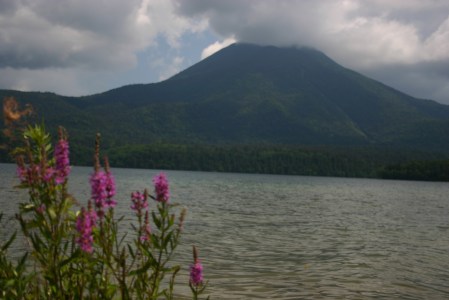
Mt. Oakan is a dormant, conical volcano situated on the shores of Lake Akan in Eastern Hokkaido. The panoramic views from the summit are incredible on the rare occasion when the cloud isn’t in.

The hike: The trail starts at the end of a gravel road. Cross over the concrete dam and enter the forest. Don’t forget to register your details in the logbook (and write your finish time when you return as well, or someone may go searching for you). The path follows the edge of Lake Akan for a short time before crossing over a concrete dam. You’ll see a wooden dock on your left. This is a great place to hang out after you’ve finished the hike. Anyway, the path heads towards the right, making its way over to Lake Taro. At one point you’ll reach an unmarked junction with a path going straight or towards the right. Take the right fork which skirts the edge of the lake before climbing back up the other side. After about 10 minutes you’ll reach another junction with a signpost marked for Lake Jiro (次郎湖). You can either take the 2 minute detour down to the lake shore or continue heading straight on the path in front of you. I recommend visiting the lake in the morning, as the lighting is much better. You might be lucky enough to catch the mist clearing off the calm waters. Retrace your steps back to the junction and continue climbing. The path becomes quite steep momentarily, but will flatten out and you’ll soon reach the 1st stagepoint (一合目). The next hour or so of hiking is a monotonous pattern of meandering switchbacks followed by long flat sections. You’ll see a few caves hidden in the moss and rocks. If you kneel on the ground you can feel the frigid air gushing out of the holes. The path starts to become a bit steeper once you  reach the 3rd stagepoint  (三合目). Continue pushing on until reaching the 4th stagepoint (四合目). Take a break here and fill up on nutrients because things are about to become tough. The next section is the steepest section of the entire hike, and if the horseflies are around, it’ll be the most agonizing. Take it slow and steady and you’ll eventually end up at the 5th stagepoint (五合目). Congratulate yourself, as you’re actually 80% of the way there. If the weather is good then you’ll see your first views down to Lake Akan. From here the trail climbs for a few more minutes before descending down to a long saddle. Your legs will appreciate the respite, but rest assured, you’ll start climbing again momentarily. The next section of the route involves another set of switchbacks, with each turn offering a better view of the lake below. If you’re really lucky then you’ll also be able to see Mt. Meakan and Akan-fuji rising up on the other side of the lake. The alpine flowers will steadily increase in number as well. After a relatively gentle climb, you’ll reach the 8th stagepoint (八合目). There’s an old foundation of a weather monitoring station here which would make for a great campsite if there were only a water source and toilets. From the 8th stage to the summit it’s a series of ups and downs. Just before the 9th stagepoint you should get your first view of the crater rim. Unlike its active neighbor to the south, Mt. Oakan’s crater is filled with grass and trees, but you could easily imagine what life must’ve been like on the peak millions of years ago. Anyway, there’s one final drop followed by a short, steep climb and you’ll reach the rocky summit. Again, if the cloud isn’t in you’ll have unobstructed views in all directions. Unfortunately it was one white, misty mess when I climbed, but click here to see the views in good weather. After a well-deserved break on the top, retrace your steps all the way back to the trailhead, taking care not to frighten any bears on the way down. There are quite a few in this area, so consider bringing a bell or bear spray.

When to go: This hike can be done from May to October, when most of the snow is gone. A winter hiking is a serious challenge and should only be attempted by those with the equipment and experience to do so.

Access: There’s no public transport to the trailhead, so you’ll either have to walk the 4km on route 240 or take a taxi. Alternatively, if you’re staying at a minshuku at Lake Akan then they might be able to give you a lift to the trailhead. Hitching is quite possible as well.

Live web cam: Click here

Level of difficulty: 4 out of 5 (elevation change ~920m)

Distance: 12.5km (5 to 7 hours)

This slideshow requires JavaScript.


Mt. Rebun (礼文岳)

August 27, 2011

Mt. Rebun is the highest peak on Rebun Island, a long, remote  isle located about 50km off the northern coast of Hokkaido. The hike is best known for the plethora of wildflowers, as well as the panoramic views of the entire island.

The hike: The path starts at the far end of the small gravel parking lot. Climb the steel stairs and head towards the right, climbing through bamboo grass. The initial 15 minutes is relatively steep, but it flattens out quite a bit after that. It’s 4km from the start to the summit, and the path is very easy to follow. The views back down to the trailhead and coast are quite nice before the path takes a left turn and heads into the bush. The forest here is outstandingly beautiful. Even though it looks like bear country rest assured: there are no furry brown creatures on the island. After an hour of gentle ups and downs you’ll reach a signpost which marks the halfway point in the hike. There used to be a trail junction here, but the old trail is now closed. (hence the reason for the vinyl cover over the signpost) Continue climbing up towards the summit through more beautiful forest land. About 1km from the summit, you’ll start to pop out above the tree line and will be rewarded with outstanding views if the cloud isn’t in. Soon you’ll reach the summit of a rocky outcrop with views of Mt. Rebun directly in front of you. There’s a short steep drop followed by a long, gentle climb before reaching Rebun’s bald summit. The panoramic views are superb, especially if the clouds over Mt. Rishiri are gone. Mt. Rishiri will be directly behind the path you just came from, while Cape Sukoton is straight ahead. Mt. Rebun is an incredibly shy island, so consider yourself lucky if you can get any view at all. After taking a well-deserved break on the top, retrace your steps all the way back to the trailhead and consider having a bath at the hot spring near the ferry terminal.

When to go: This hike can be done from May to October, when most of the snow is gone and the buses are running. A winter hike is also possible, but be prepared for windy, cloudy, and snowy conditions.

Access: From Wakkanai Ferry Terminal, take a ferry bound for Kafuka (香深) Port on Rebun Island. From there, take a bus bound for Sukoton Cape (スコトン岬) and get off at Nairo (内路). The trailhead is near the post office, so look for the sign that says “Mt. Rebun Climbing Trail”.  Click here for the schedule for May and September, and here for the schedule between June and August. Hitching to/from the trailhead is also quite possible, and if you stay on the island, your place of accomodation might be able to give you a lift as well.

Level of difficulty: 2 out of 5 (elevation change 490m)

Distance: 8km (4 to 5 hours)

This slideshow requires JavaScript.

Mt. Hiko (英彦山)

July 26, 2011

Hikosan is a sacred peak nestled on the border of Fukuoka and Oita Prefectures in northern Kyushu. Unlike its volcanic neighbors, the peak is known for old growth cedar trees, rustic shrines carved into cliffs, and an ambiance you’d expect to find in the hills of Kansai.

The hike: Please note that you can also start this hike from the back side of the mountain at Buzenbou, but you’ll miss out on the impressive shrine at the top of the slope car. From the bus stop, walk a few meters in front of the bus and on your right you’ll see a huge bronze shrine gate with the characters “英彦山” carved on the front. Follow this stepped-stone path all the way to the terminus. It should take about 20 minutes of steep climbing to reach the top of the stairs. Here you’ll find the immense, bark-roofed shrine of Hikosan-Jingu. On the stone path to the shrine you’ll find plenty of stone lanterns and a rather rustic thatched teahouse on your left. It all reminds me a bit of the scenery in Kyoto, somehow magically transformed to the hills of northern Kyushu. If you’re feeling really lazy, then you could just skip this first step and board the futuristic slope car up to the shrine, but it’ll set you back 500 yen. Anyway, once at the shrine, you’ll find a path leading towards Nakadake (中岳) just in front of you. The path is very well worn and it’s just about impossible to get lost. You’ll start by meandering through the forest via a series of switchbacks until reaching Chuuguu shrine (中宮). After this, the path starts to flatten out a bit, and it really starts to open up just before Musubi shrine (産霊神社). Here you’ll once again start following the stone steps through a grassy area with lots of dead trees. At the top of the stairs you’ll reach the summit of Nakadake (中岳), where you’ll find a large, weather-beaten shrine building. Take a quick break here and admire the views down the valley. There’s a junction here, so turn left if you want to climb to Kita-dake and descend to the bus stop at Buzenbou. Otherwise, turn right and drop steeply to a saddle before climbing up to Minami-dake (南岳), Hikosan’s highest point. There’s not much of a view here, unless you climb the rusty metal lookout tower that is officially off-limits. I wouldn’t trust that thing with my weight and I really wish the prefecture would spend some money to remove that thing. Make sure you rest the knees here, as things are about to become a bit tricky. If you’ve got vertigo, then definitely skip this next section and retrace your steps back to the shrine. The path drops steeply off of Minami-dake’s rocky face. There are plenty of metal chains to help you through the gnarly sections, but this is definitely not a place you’d want to fall. Take your time and definitely make sure you go down the chains backwards, as it’ll help you with balance. Luckily the chain section is relatively short, and you’ll find yourself back in the forest soon enough. Now, at your first junction you’ve got a decision to make. If you take the path to the left through the downed trees, then you’ll reach an 1200-year old cedar tree. If you ignore this path and continue straight and take your first left, then you’ll reach Daiminami Shrine (大南神社). From the shrine you can take a path down to the cedar tree. I must admit that I took the initial left and ended up missing Daiminami Shrine completely. It helps to have a detailed map in this place. Anyway, the name of the tree is called Onisugi (鬼杉) and it’s a sight to behold. Just to the left of the tree you’ll find a large rock outcrop, and this is the path you want to take. Don’t take the trail leading away from the tree towards the south or you’ll end up on a forest road. The path skirts the edge of the rock cliff before climbing up towards Tamaya shine (玉屋神社). Just before the shrine, you’ll find an unmarked junction. Turn right and you’ll climb a set of stone stairs to the front of the shrine. If you’re staying at Shakunage-sou (しゃくなげ荘), (permanently closed)  then take this unmarked path down to the forest road and turn right for the easy walk to the lodge. Shakunage-sou is highly recommended, with spacious rooms, tasty meals, and a wonderful hot spring bath. permanently closed (as of 2020). If you’re just visiting Hikosan for the day, then continue to Tamaya shrine and take the path passing in front of the building. This route will take you all the way back to Houheiden (奉幣殿) at the top of the slope car. All in all, it should take about 4-1/2 hours to complete the entire loop.

When to go: This hike can be done year round, but you’ll need to be prepared for ice and snow during the winter months. The autumn foliage is spectacular, but so are the crowds.

Access: From Kokura (小倉) station, take a train on the JR Hitahikosan Line and get off at Hikosan (彦山) station. From there, change to a bus bound for Buzenbou (豊前坊) and get off at Kane-no-torii (銅の鳥居). The front of the bus usually just says Hikosan (英彦山) and it’s usually timed to meet up with the infrequent trains. Click here for the bus schedule.

 Live web cam: Click here

Map: For once there’s no shortage of decent maps! Click here for a printer-friendly illustrated color map.

Level of difficulty: 4 out of 5 (elevation change 570m)

This slideshow requires JavaScript.

Mt. Shiraga (白髪岳)

May 22, 2011

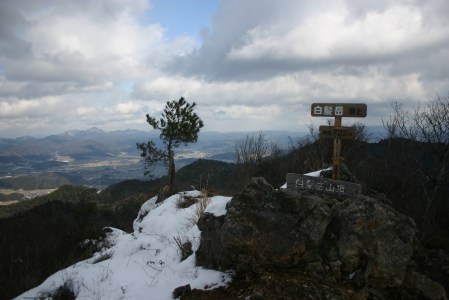
Mt. Shiraga is a bald, rocky peak sandwiched between Sanda and Sasayama cities in central Hyogo Prefecture. The unspoilt panoramic views and tranquil forest make it one of Kansai’s hidden treasures.

The hike: Go out the only exit at Furuichi station and turn right on the road in front of you. Hang a quick left at the first road you come across, followed by a right on the main street through town shortly after that. You’ll pass by a few old houses before reaching the railroad tracks. After crossing the tracks, the road merges with route 372 and you’ll see an elevated walkway on the right side of the street. The walkway parallels the road and is about 1.5 meters above the street. The road bends to the right and the elevated walkway ends. As soon as it ends, take a right on the street running through the countryside. You should see a small sign white sign that says “白髪岳●松尾山 住山ルート”.  The road passes through a lot of fields and a few thatched farmhouses. There’s very little traffic, so it’s a nice taste of country life. Follow this road for roughly 45 minutes, and you’ll reach a fork in the road. Just before the fork, you’ll find a huge billboard-sized map (案内図). Turn left at the fork, following the sign that says “白髪岳方面”. The deserted forest road passes through an orchard before climbing up into the forest. It should take about a half-hour to reach the trailhead near the end of the forest road. If you’re coming by car, then you should be able to drive this far, though the road is rough and there’s not much parking here. Anyway, you’ll find a small gazebo and a water source here, so fill up your bottles. The path starts next to the gazebo and follows the stream for a short way before suddenly and quickly veering off towards the right, into a cedar forest. The path climbs quite steeply at first before reaching a junction. Turn left at this junction, traversing along the side of the mountain and into a beautiful virgin forest. The trail winds its way though the trees until reaching the ridge line. It’s a pretty short climb but somewhat steep. Once you hit the ridge, you’ll find a nice lookout with a wooden bench. Take a rest here, because things are about to get a little challenging. You can see the rocky summit of Shiraga in front of you, so keep climbing up the ridge until reaching your first set of rock formations. Ropes will assist in making the ascent somewhat easier, but be careful not to bang your knees on any boulders. After a series of false summits and narrow rock passages, you’ll pop out on the summit and be rewarded with a spectacular panoramic view of most of the mountains in Hyogo Prefecture. The top is surprisingly spacious, with lots of rock formations to relax and enjoy your lunch. If you’ve come during the week, you’ll more than likely have the entire place to yourself. After taking a rest, continue scrambling on the rocks away from the signpost and you’ll find a trail descending down the northern face of the mountain. This trail is quite tricky in the winter when there’s snow and ice, but otherwise manageable thanks in large part to the ropes tied to the trees. The knee-knocking descent is short but sweet and you’ll soon be sitting on a saddle. Take the trail to the right that skirts the large peak in front of you. This trail will meet up with the main ridge after about 10 minutes. Continue hiking on the ridge towards the east, following the signposts for “松尾山山頂”. You’ll be able to glimpse across the valley on your right towards the peak you just came from. The route will reach another saddle, with a trail branching off towards the left towards 文保寺. Ignore this trail, as well as the path to the right, and follow the steep path just to the right of the sign that says 鐘掛の辻. After a sweaty 10-minute slog, you’ll pop on on the summit of Mt. Matsuo. The views aren’t as great as on Mt. Shiraga, but the history makes up for it. There used to be an old castle up here, and you can still see some of the foundations in places. From the summit, head south, following the sign that says 卯塔群より住山. The path drops past a really old cedar tree before reaching a rock outcrop. The outcrop is a little off the trail to your left, so look out for it. There are really nice views into the valley below, so it’s a nice place for a break. Continue descending on the ridge and after 30 minutes or so you’ll reach a clearing with a lot of old jizo statues. Don’t take the trail that goes down the other side of the statues. Instead, take a sharp left turn on the path that is marked 高仙寺本堂跡より住山へ. The trail cuts through a dense forest before arriving at the temple ruins. There are two sets of ruins, and at the last one you’ll find a path on your right marked 不動の滝より住山へ. The route drops quickly to a beautiful moss covered waterfall. This is the perfect place to meditate and ponder about life. From here it’s an easy descent down to a forest road. Once you reach the tea fields on your left, the path meets up with the paved road again, which will take you all the way back to the station. If you’ve met any other hikers on the trip, then you might want to ask them for a lift to the station. All in all it should take about 6 hours to complete the loop, depending on your pace.

When to go: This hike can be done year round, but bring a light pair of crampons in the winter, as the northern face of the peak can get quite icy. Autumn is the best time to view the foliage, but winter usually has the clearest skies.

Access: From Osaka  (大阪) station, take a kaisoku train on the JR Fukuchiyama line (福知山線) bound for Sasayama-guchi (笹山口) and get off at Furuichi (古市) station. The train ride takes about 1 hour. You can also take the JR Tozai (東西) line from Kyobashi (京橋) station if you’d like. Take note that Furuichi is an unmanned station.

Level of difficulty: 3 out of 5 (elevation change ~500m)

Distance: 12km (5 to 7 hours)

This slideshow requires JavaScript.